“Thank you to all our relatives”: Bringing a Native American perspective about caring for Nature to Newtowne
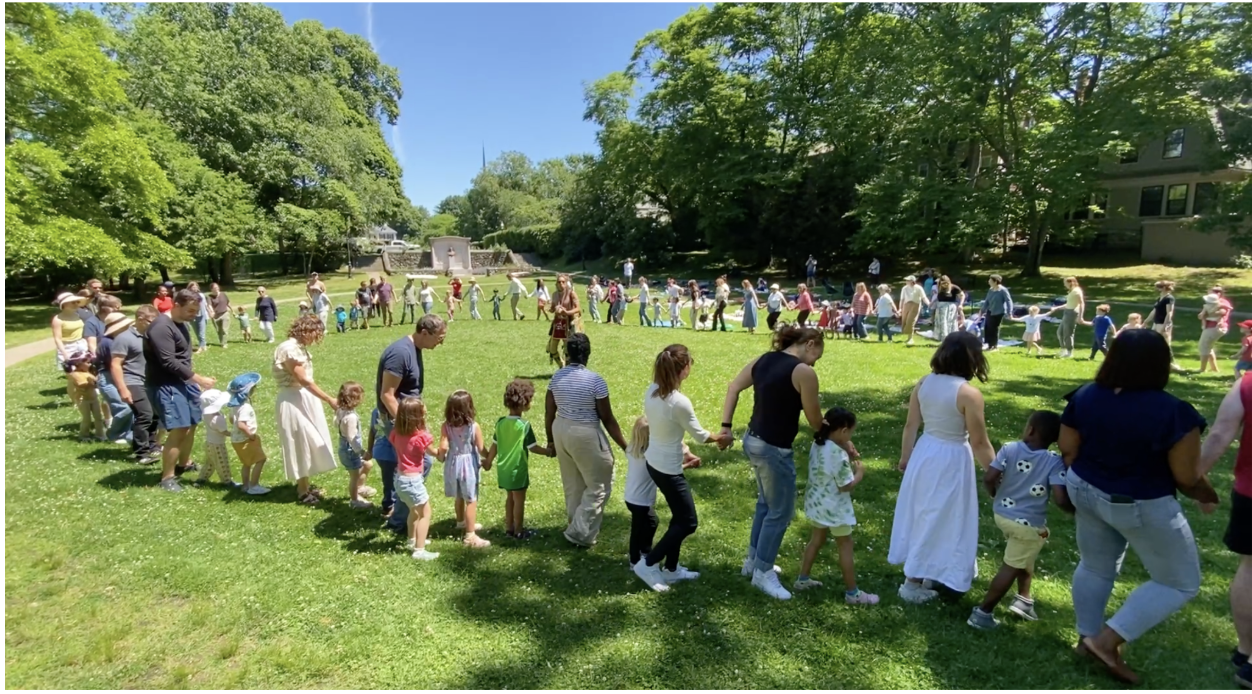
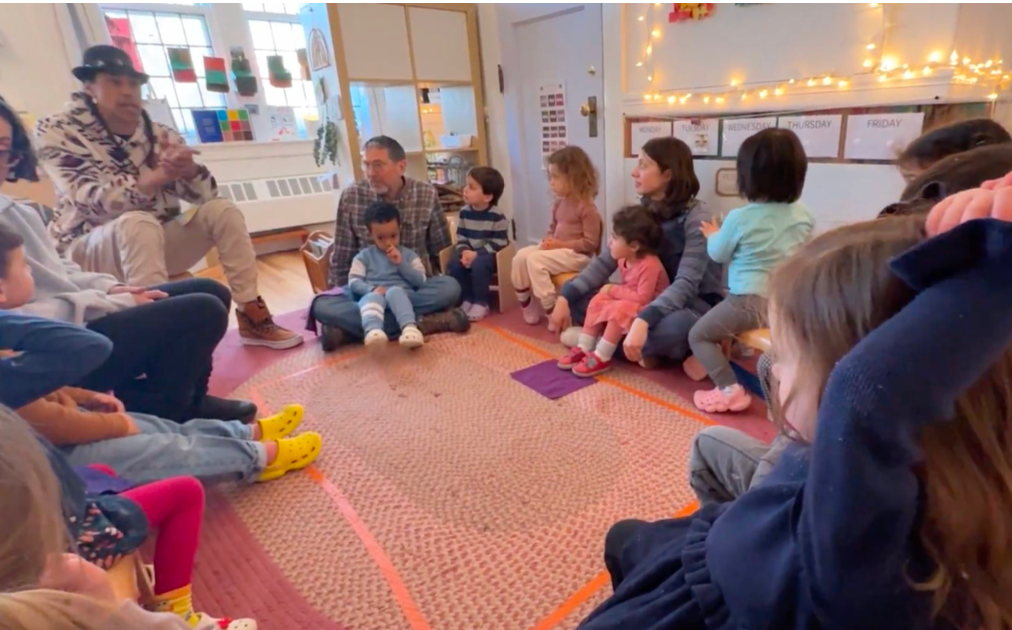
Fifty-five children, fifteen teachers, and seventy family members (parents, grandparents, and younger siblings)–the bulk of the Newtowne Community–are at a local park for our end of year All School Field Trip. We have gathered in a large circle. Annawon Weeden is in the middle, leading us in the Circle Dance. Holding hands and following the beat of Annawon’s drum, we move together as a group.
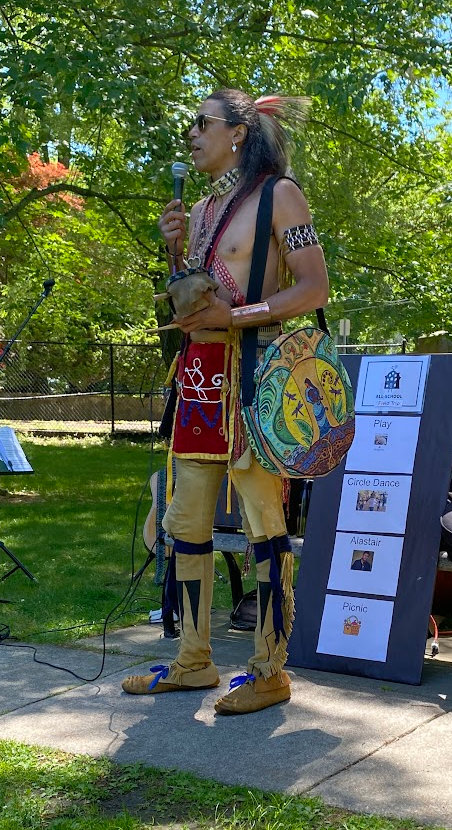
A few minutes earlier Annawon, who had been working with the Purple Fish (the three-year-old class), said a few words about the dance:
Quay. My name is Annawon Weeden, I am a Mashpee Wampanoag artist and educator. Kutaputunumuw. When I say thank you to all our relatives I’m not just saying thank you to our human relatives, but also thank you to our plant and animal relatives. We do the Circle Dance any time we gather. It is a way to express our gratitude. Gratitude that we are together. Gratitude that we have this space to gather. Gratitude to all the critters and trees and plants and water and air that sustain us.
Annawon then invited us to make a circle. We held hands and danced. It was fun.
And it was more than fun. It was powerful. Powerful to be together as a community, on a beautiful late spring day, expressing our thanks for the abundance that the earth provides us.
Annawon began working with the Purple Fish in January. His weekly visits included sharing artifacts (a turtle shell; bird feathers; a water drum) for the children to explore during choice time. He led gatherings where he told stories and taught dances (including the Round Dance, which we coined the Circle Dance at Newtowne). He had lunch with the children, chatting about, for example, their respective meals. Here, Annawon met some family members who occasionally joined the group at lunch. At nap time Annawon, the Purple Fish teachers Jenna Rounds, Sam Liptak and Franny Alani, Newtowne’s director Caitlin Malloy, and myself (the school’s studio teacher) debriefed the visits. We reviewed documentation of the children’s experiences, discussing photos, video, and children’s stories. We then made plans for Annawon’s next visit and for what we might do in the classroom and studio in the intervening days.
This essay explains the importance of bringing Annawon to Newtowne; how adults and children have much to learn from the caring relationship Native Americans have to the rest of nature. Three of the threads of inquiry (two for the children and one for the adults) that were outgrowths of Annawon’s visits are then described. The essay concludes with a section about how Annawon’s time at Newtowne has expanded the circle of care for children and adults alike.
Why a Native American perspective about Nature is needed
The science is clear: human activity is damaging the earth. Greenhouse gases are causing an unprecedented warming of the earth. It is imperative that humans move from an extractive to a sustainable relationship with our planet. Early childhood educators can contribute to this effort by fostering young children’s solidarity with the rest of nature, having them come to care about the plants and animals we share our planet with. The hope is that when they are adults, and even before, that they will make decisions that take into account the rest of the natural world.
One place to look for lessons about fostering young children’s solidarity with nature is the practices and knowledge of indigenous people. Many Indigenous cultures have long understood humans as part of the natural world, emphasizing relationships of reciprocity, responsibility, and interdependence with other living beings and the land. For example, the people who lived in what is now called Cambridge (the home of Newtowne) before European settlers arrived had a very different relationship with the rest of nature. Current-day residents of Cambridge have much to learn from the Native Americans whose land we live on.
The idea of bringing a Native American educator to work at Newtowne was inspired by a trip I took to Australia in March 2025. During my visit I learned of ways early childhood programs were incorporating aboriginal perspectives into their curriculum. Of particular interest was the teacher-research project Making Kin: Care and Ethical Obligations in Inter-creature Relationships. The research team–educators at MLC Kindle in Melbourne, Stefania Giamminuti at Curtin University, and Murrundindi, a leader of the Wurundjeri people–explored how to foster children's interest, care and solidarity with the rest of the natural world. Over the course of the two-year project, they would review documentation to plan curriculum that aligned with their learning goals and the children’s interests. The research, which brought an Aboriginal perspective into planning, was a model I wanted to emulate.
With the support of Caitlin and through an intensive networking effort, we got in contact with Annawon. Annawon is an educator dedicated to bringing the culture of his people into schools. His work typically involves visiting a school just once a year, and he had never worked with three-year-olds before. His visits with the Purple Fish were new territory for all of us. In this first year of our work together, meaningful relationships began to take shape and the children’s circle of care was expanded.
Turtles
Annawon began his time with the Purple Fish by sharing the story of Turtle Island, a Native American creation myth. The story tells of how Father Sky pulls up a tree, creating a hole in which the sky people look down to earth. Sky Mother falls through the hole and lands in the ocean. This is a big problem since she cannot swim. She is saved by a turtle who allows her to climb on its back. A muskrat then brings Sky Mother soil from the bottom of the ocean which she spreads over the turtle’s shell. There she plants seeds.
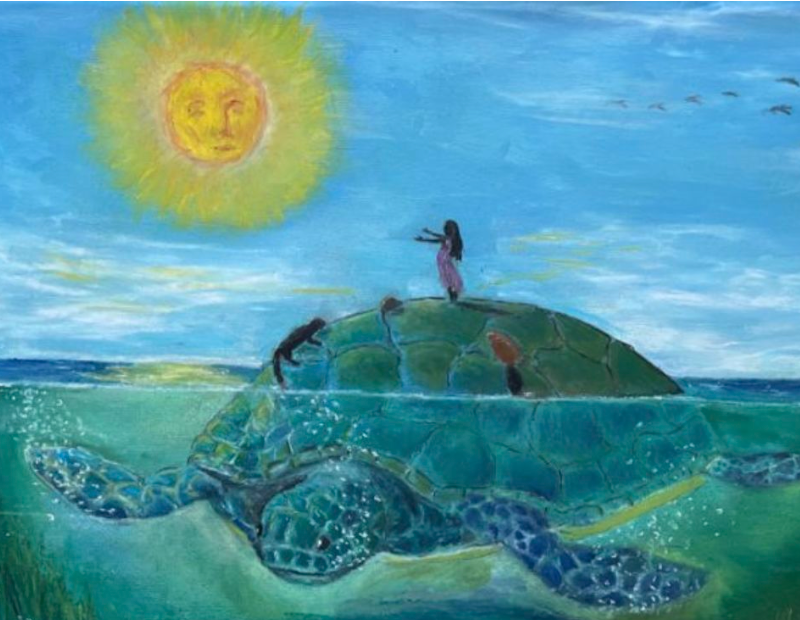
The resulting forests and fields make homes for deer, foxes, rabbits, buffalo, coyotes, and more. The world as we know it is born.
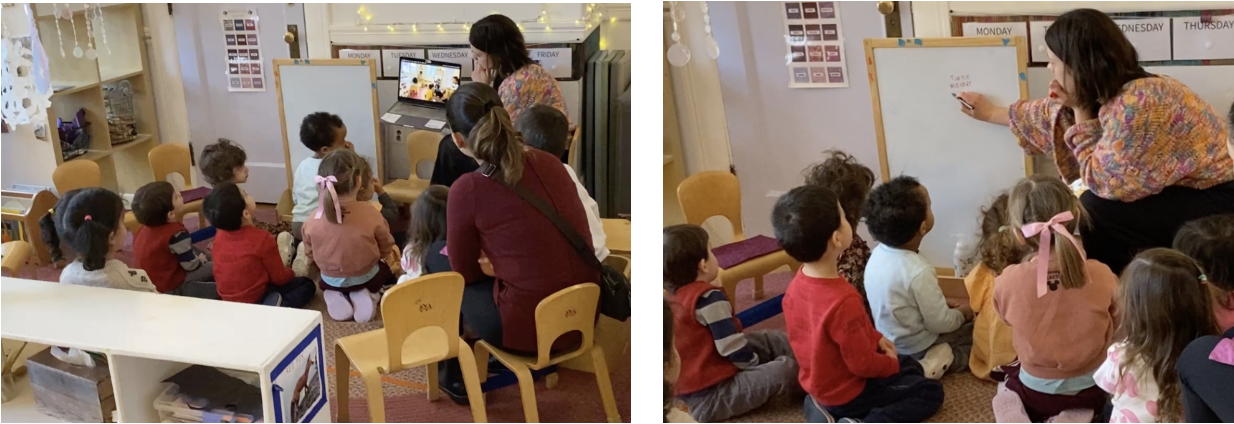
At our debrief meeting that afternoon we watched a video of Annawon’s telling. Despite its length (15 minutes), that it was told by a stranger, and it happened right before lunch, we were impressed by how many of the kids remained engaged by the story. When it came time to decide what to do next time it was clear to Jenna, Sam, Franny and I: tell it again! After explaining to Annawon the value of three-year-olds hearing stories multiple times, he agreed to repeat the story during his next visit.
The next Friday, Annawon shared the story a second time. The following week, the Purple Fish teachers helped the children prepare to enact Turtle Island in anticipation of Annawon’s upcoming visit. Sam showed the children a video of Annawon’s telling and helped them make a list of the characters in the story. The children watched video of muskrats and turtles and discussed how they moved. They practiced being Sky Woman, falling through the hole to earth.
When Annawon returned on Friday he told the story as the children acted it out. There were smiles on everyone’s faces.
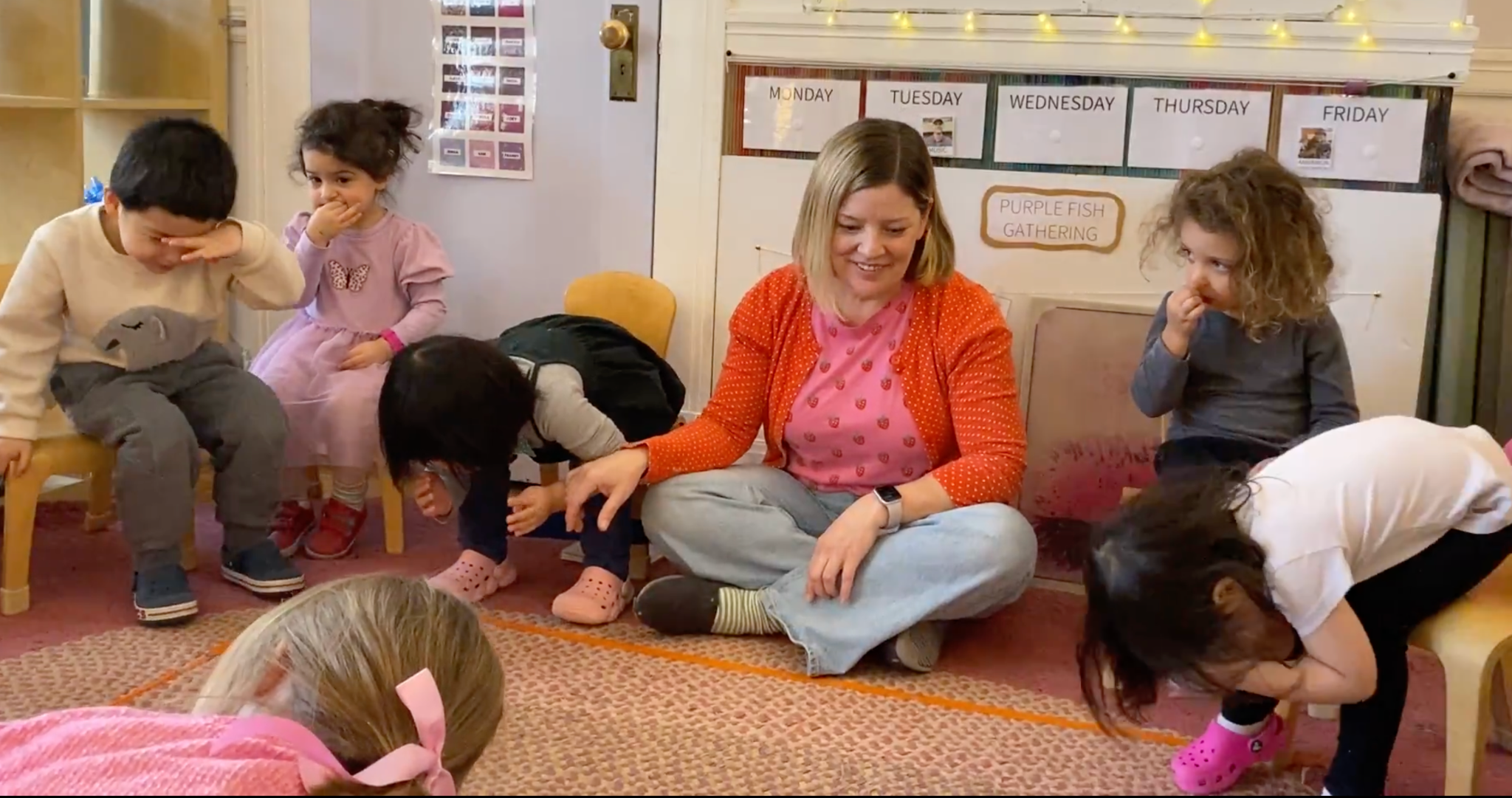
Inspired by the schools in Reggio Emilia, Italy, at Newtowne we practice a form of emergent curriculum. Rather than following set plans (e.g., it is January, time to study snow) we make decisions based on the children’s interests and our learning goals for them. At this point, there were lots of directions the Purple Fish’s curriculum could have gone. There could have been a focus on seeds and soil, muskrats, or creation stories. We had to decide what we thought the children might come to care about (be interested in) and what we thought would be valuable for them to care about.
We decided to focus on turtles. Fascinating creatures (how they retract into their shells, their ability to live on land and in the water), turtles can live to be 100. Annawon explained to us that in Wampanoag culture they are known for their wisdom and that their shells are used as calendars. Turtles are also residents of Cambridge, so we knew it was possible that we could take a field trip to see them when the weather got warmer.
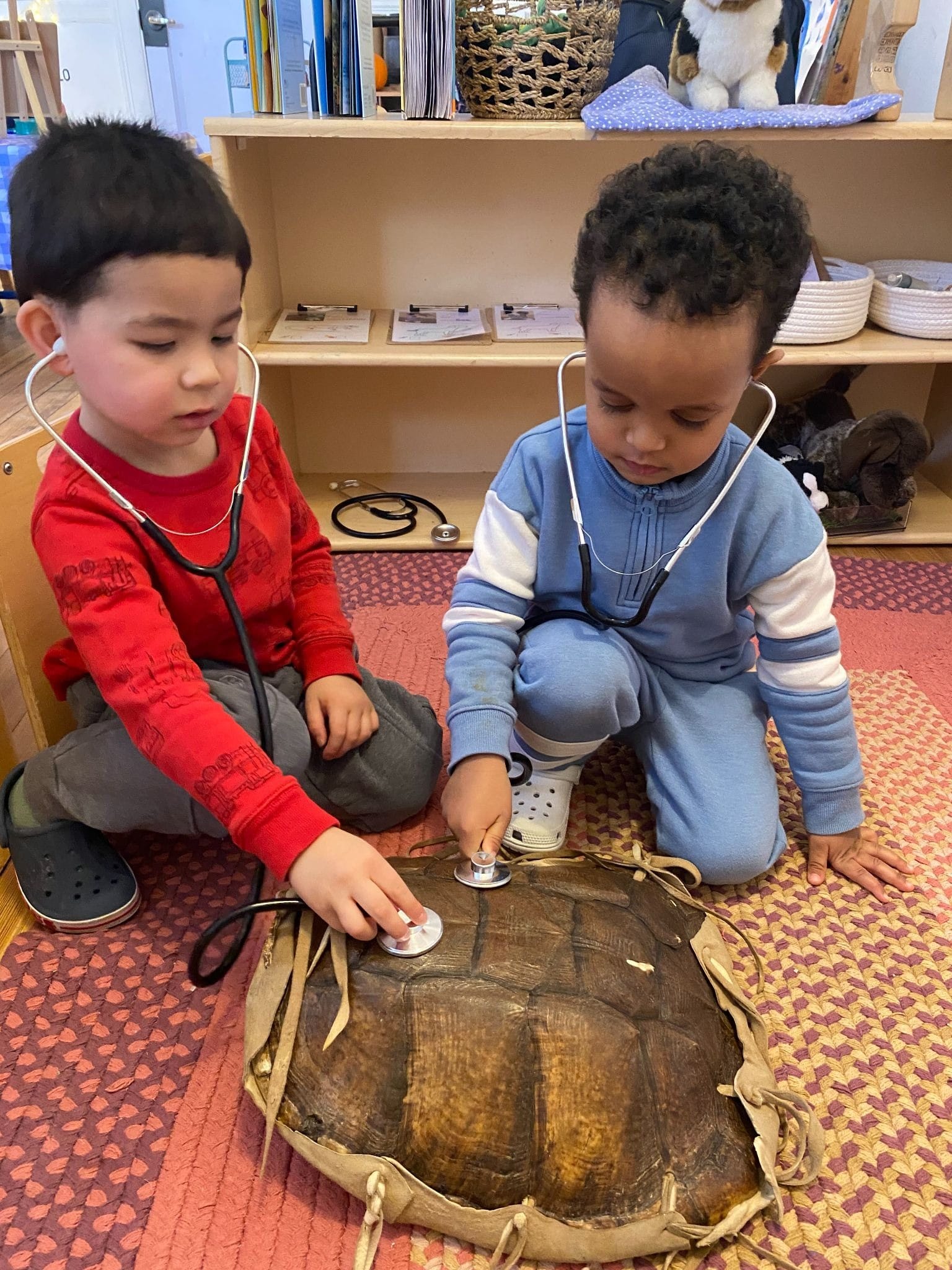
The Purple Fish inquiry into turtles, which spanned several months, was both factual and fanciful, taking place in the classroom and during the children’s visits to the studio. Annawon brought in a giant Snapper shell. He allowed them to explore the shell in ways three-year-olds do, pretending to be a turtle by putting the shell on their backs, and bringing over stethoscopes from the dramatic play doctor’s office to listen for a heart beat.
The children watched videos of turtle hatchlings emerging from their eggs, giant sea turtles gracefully swimming, and eastern painted turtles trudging along on land. They helped paint a diorama of a turtle habitat.
And they made observational drawings of the patterns on turtle shells. As she drew her turtle Daphne announced, “I’m making myself as a turtle.”What an interesting thought, and an important pathway to care, imagining herself as a turtle. Daphne’s declaration was the impetus for a book called, If I was a Turtle. In Studio the children were given a turtle cut-out with their photo on its head which they could decorate how they wished.
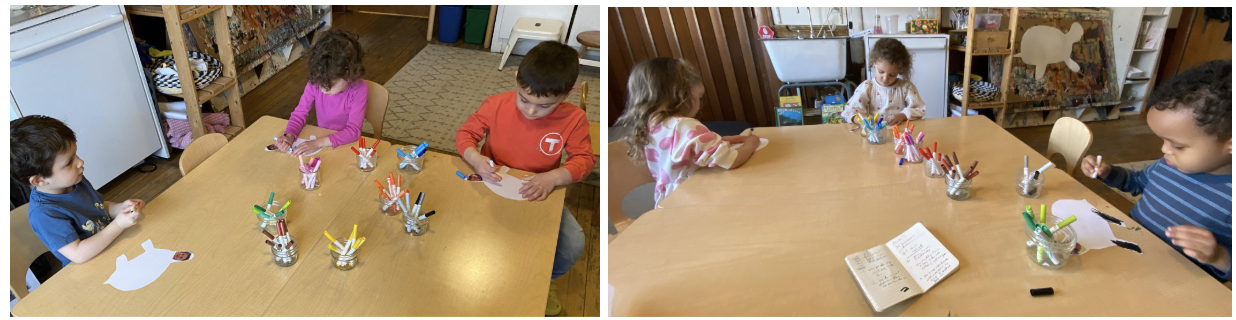
Some children drew “rainbow turtles” while others chose a color scheme similar to an actual painted turtle.
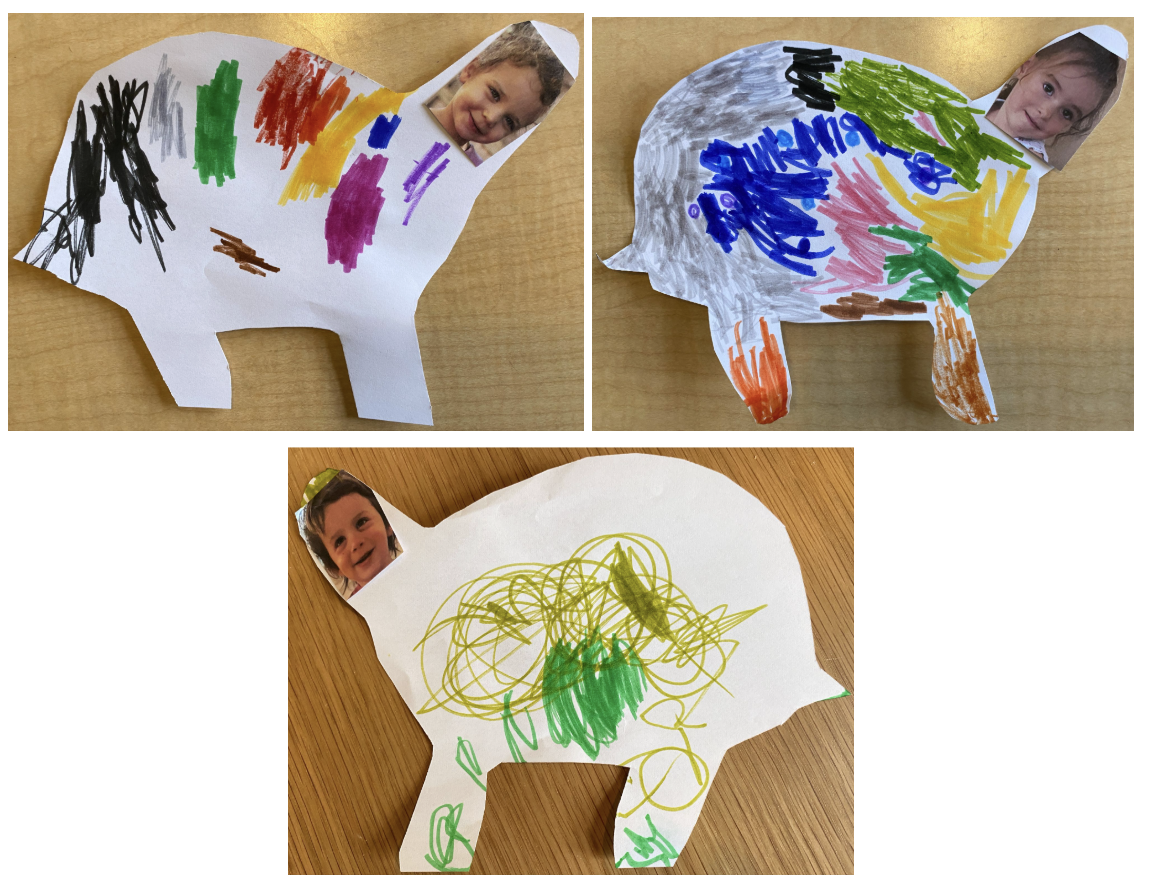
I then asked the children to tell me what they would do if they were a turtle. Playing and eating with friends and siblings were popular answers:
I would jump and flip and talk and play with Ino and Enlin. And grab a marker with my tail. I’m colorful! Black, green, pink, purple, and yellow and red (Liran).
I would play with my sister and brother with my toys at my house. I would eat grass (Adriana).
I would play with Afomia and Owen. I would eat chips. I would go on the train to Turtle Beach (Nowali).
I would play basketball with Ooloo. We would eat blueberries and bananas. He’s my best friend (Lionel).
Note: Oollo is a turtle and Lionel’s imaginary friend who he began talking about during the inquiry into turtles.
Book completed, I read it to the Purple Fish at a gathering. They excitedly called out the names of their friends as I turned the pages.
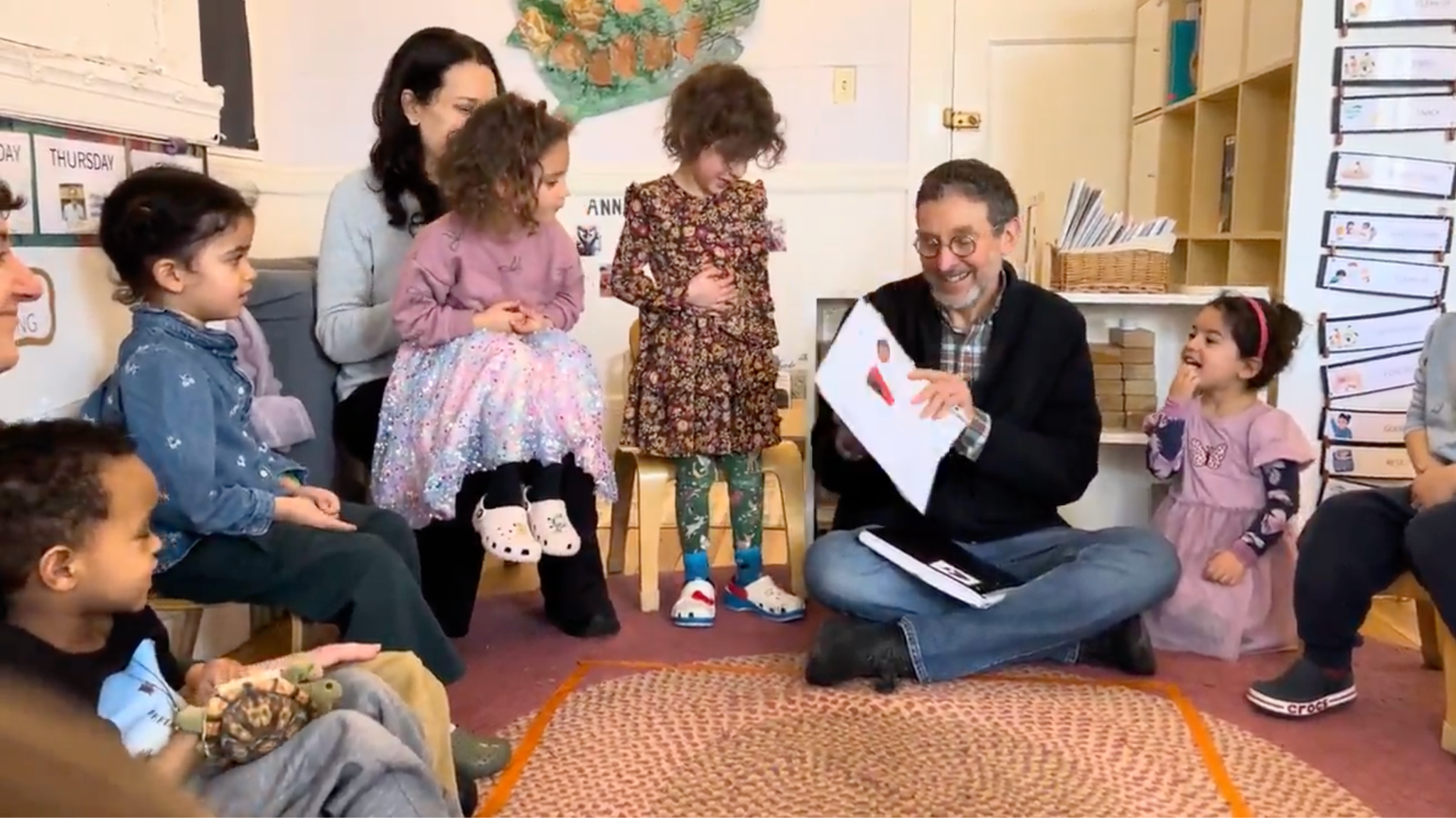
During their visits to the Studio, I would invite the Purple Fish to tell stories that we would enact back in the classroom. Children began telling stories with a turtle as the main character, again imagining what it was like to be a turtle:
There was a little turtle walking down the street and she was very, very lonely. Not with her mommy and not with her daddy. And then her mommy found her and brought her to her home. And then she sleeps. And then she woke up. And then she brushed her teeth and went to school (Teresa).
There was a turtle and then it went to a town called New York City. And then the turtle went to the New York City Ballet. And Clara was on the stage. And the turtle wondered, “Could I dance ballet on the stage?” “But if you are a little bit older,” her mom said. The end (Clara).
Through storytelling, drawing, and play, the children were forming relationships with turtles.
The capstone of the turtle inquiry was a visit to a pond on the edge of our city. There, especially on sunny days, it was possible to observe turtles lounging on logs close to the shore. However, one week out from our scheduled visit the forecast was for rain. Not ideal weather for turtle sightings.
Luckily, it was a sunny May day when the Purple Fish and a half dozen family members boarded a city bus to take us to the pond. There was great anticipation among the children about getting to see actual turtles. The bus ride was exciting in itself. Getting off at a stop we had dubbed “Turtle Beach”, we were met by Ranger Amanda who told us of the different turtle species (common Snappers, Eastern Painted) that live in the pond.
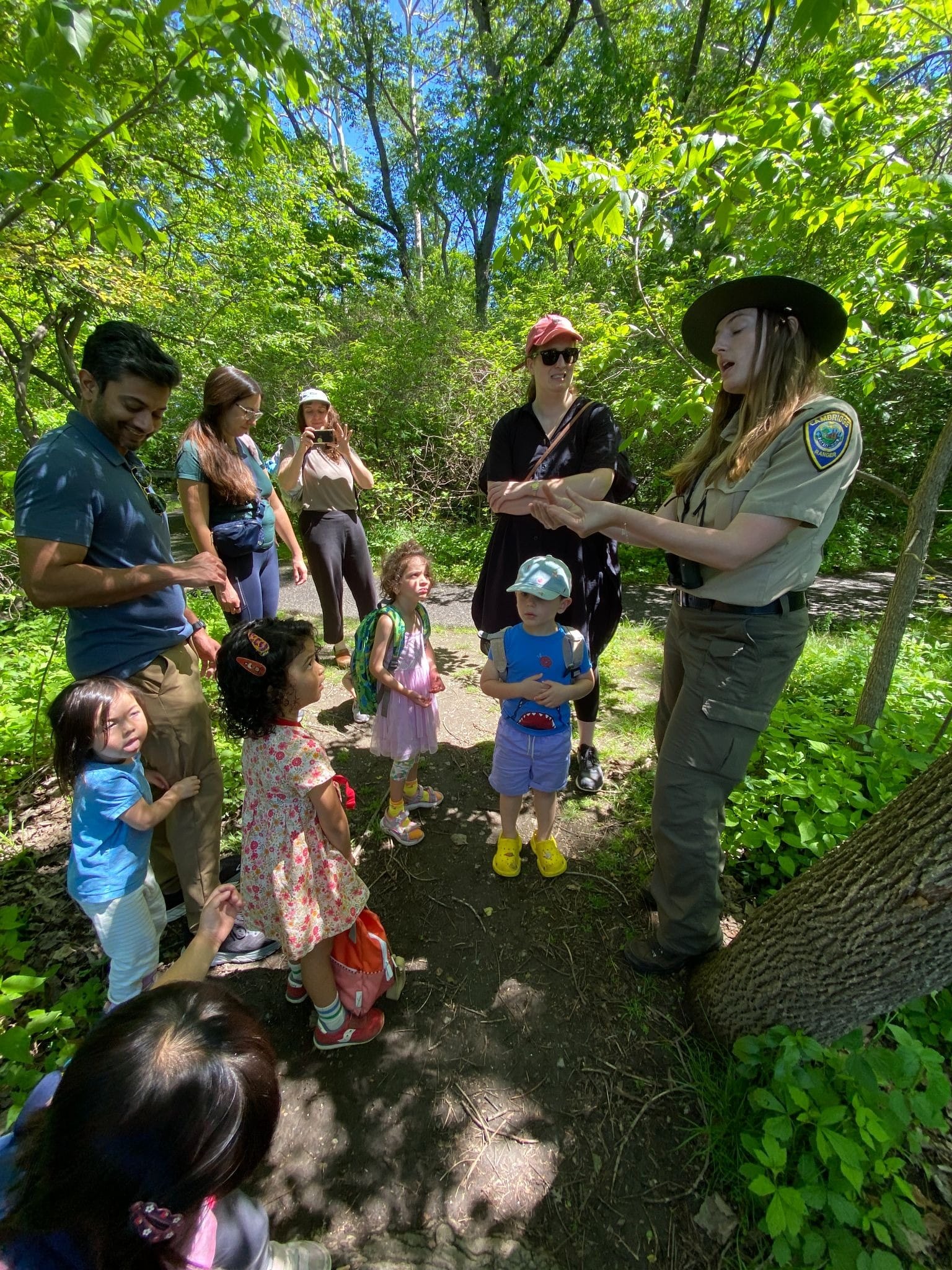
The children had a chance to draw the flora and fauna that they observed on the pond.
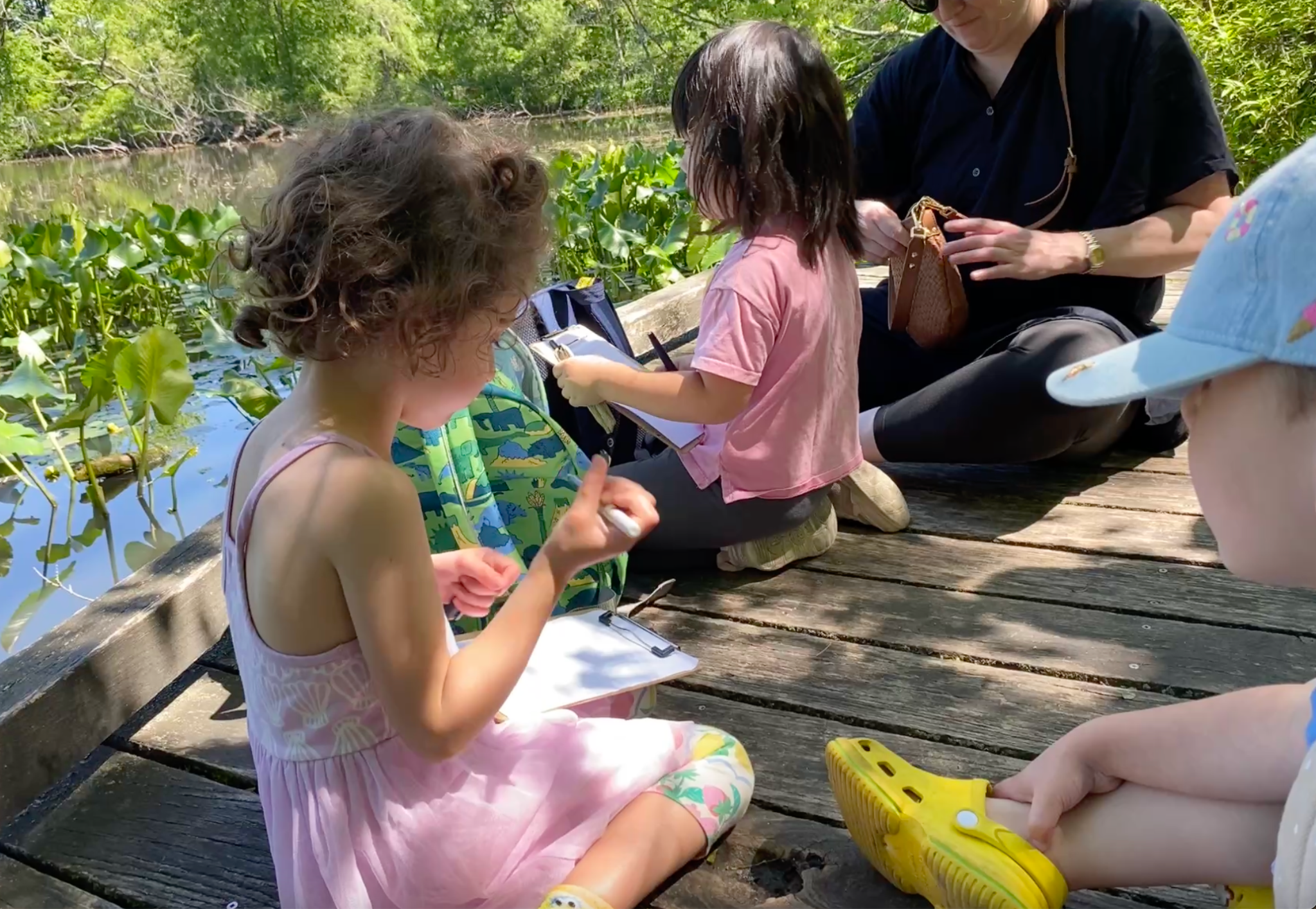
And we got to see a dozen turtles basking in the sun! It was exciting to get to see our friends in person.
Postscript. During the summer, Purple Fish teacher Sam visited New York City. Walking through Central Park, she encountered turtles. Her immediate impulse was to snap a photo and send it to her co-teacher Jenna. Turtles had taken on new significance for adults and children alike.
The Circle Dance
The Circle Dance was a second line of inquiry inspired by Annawon’s visits. He introduced the dance to the Purple Fish at a gathering in March. As he and the teachers helped children get into position, he told them, “See how we can look across the circle and see all our friends’ faces.” To encourage them to keep holding hands he explained, “You don’t want to break the circle. We don’t want to lose our friends.”
The dance takes a fair amount of coordination, putting feet in and out of the circle in unison, and moving around, first to the left and then the right as a unit while holding hands. At first, this was hard for the children and the circle did not always hold.
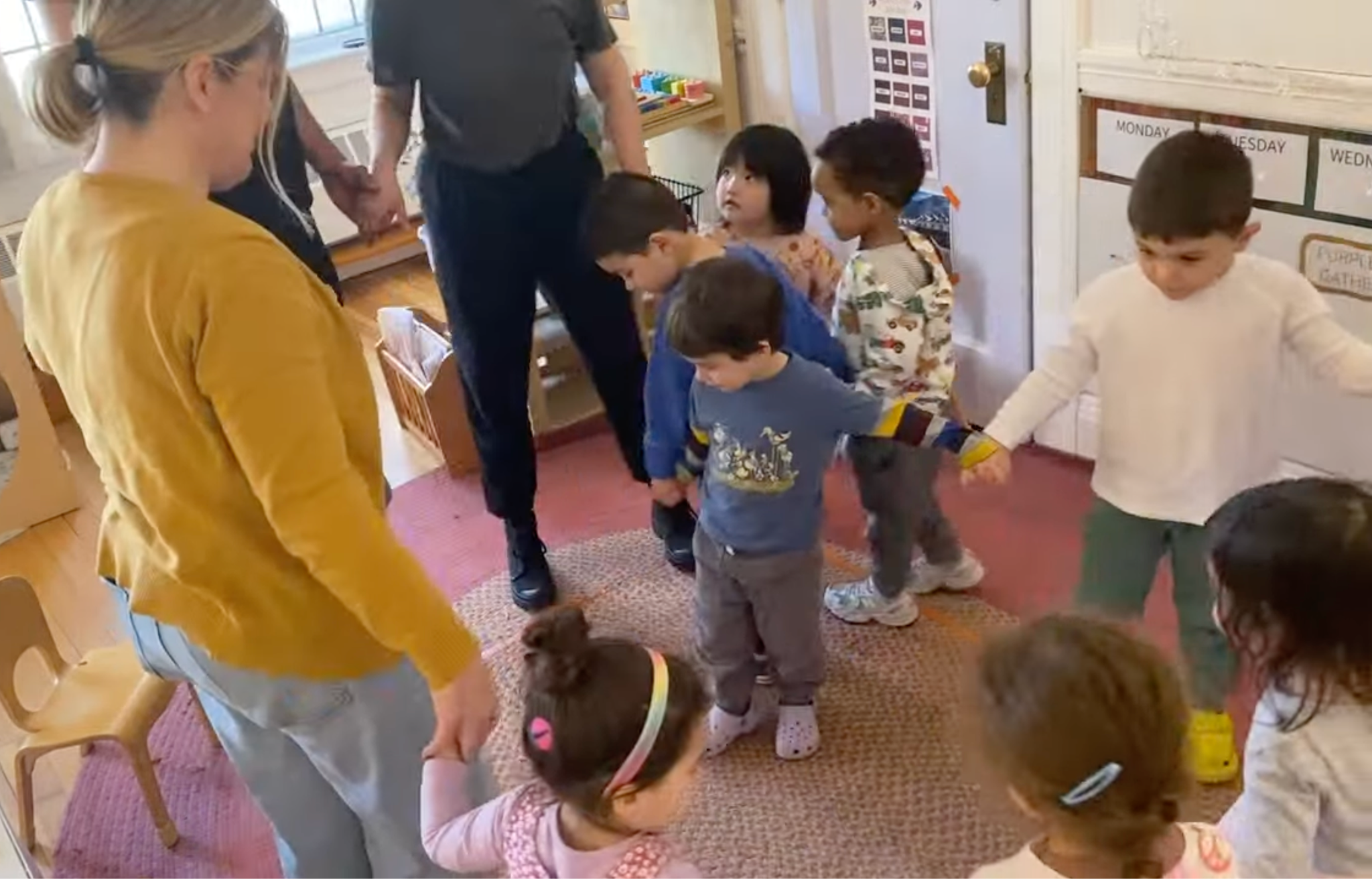
Despite the difficulties, the children enjoyed the dance, especially the end when Annawon called out “woo, woo, woo” as a signal for the circle to collapse and for everyone to meet in the center. This produced lots of laughter.
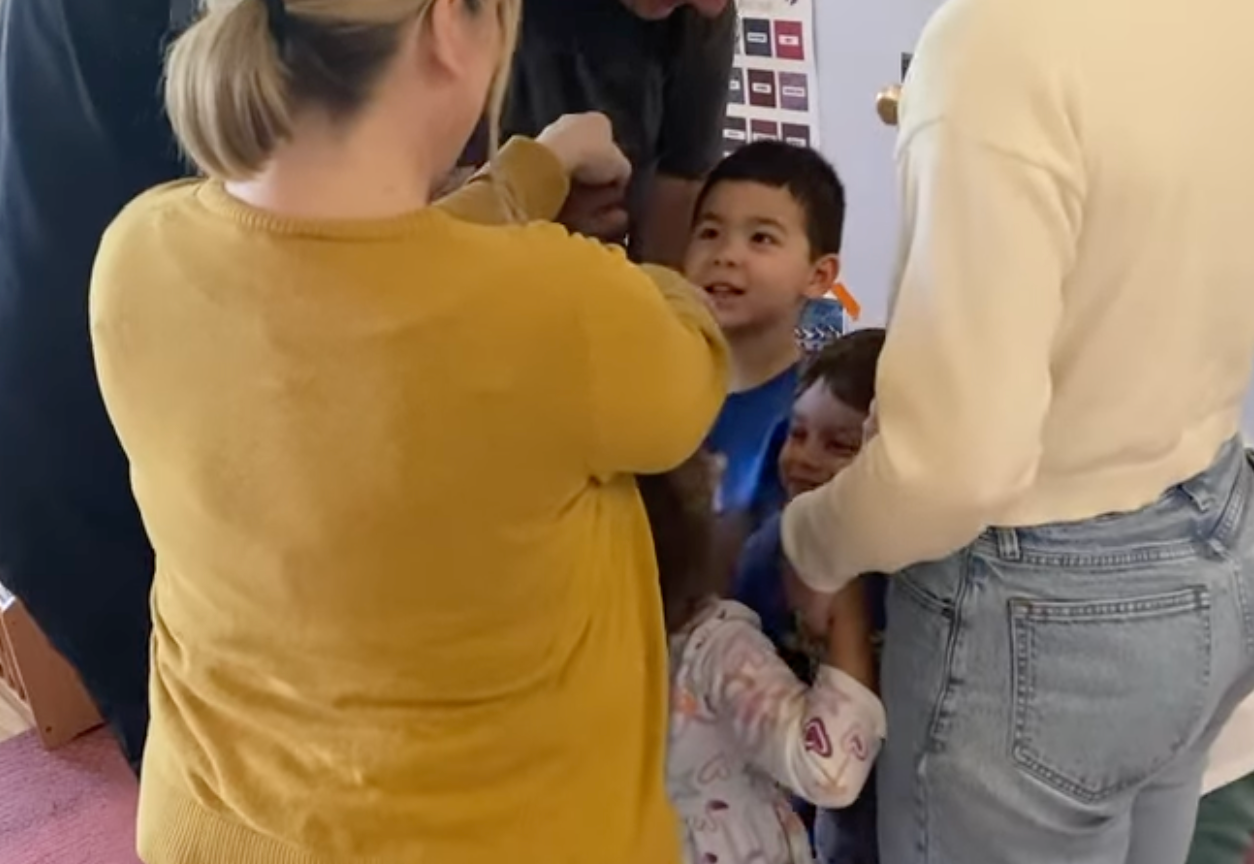
Over the next few weeks, Annawon would bring his water drum in for the children to explore during choice time. At gatherings, he would use the drum to lead them in the Circle Dance. Several times during the choice time, spontaneous dancing would break out.
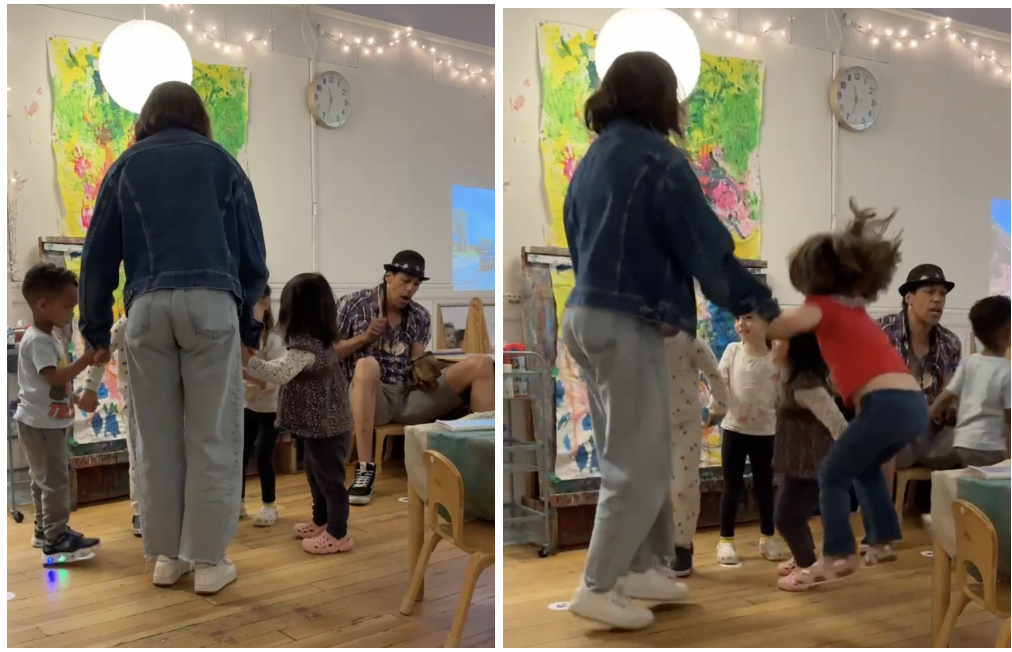
Over time, children improved in their Circle Dancing. Inevitably, due to pre-lunch fatigue, at least one or two children would sit out the dance.
Then came an invitation from our director Caitlin to share the Circle Dance at our monthly All School Gathering. When Caitlin called on the Purple Fish to come up in front of the entire school, all the children came forward.
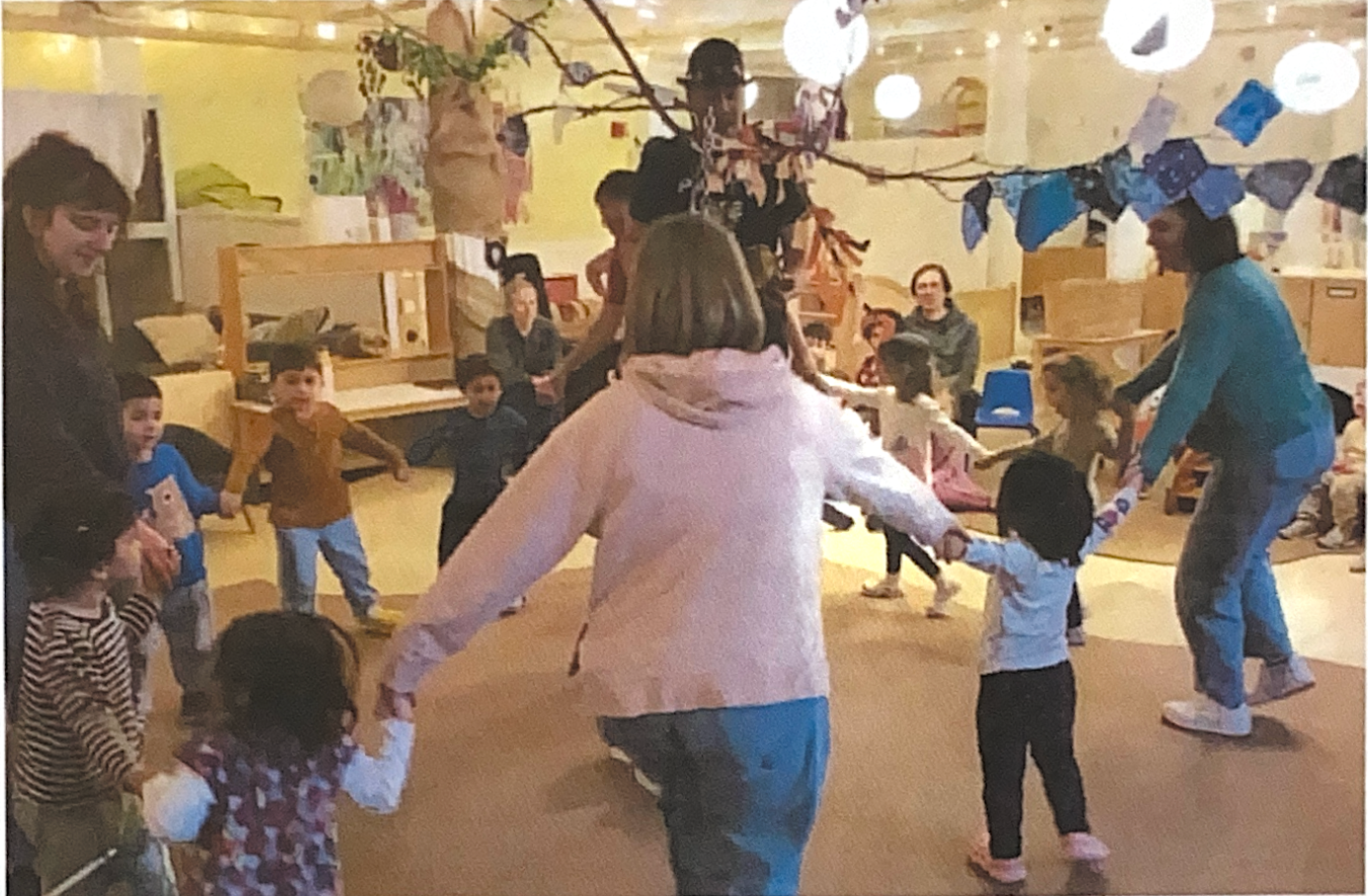
The Purple Fish demonstrated the dance as a cohesive classroom community.
Watching a video of the All School Gathering demonstration, the children noticed themselves, their friends, their teachers, and Annawon. They observed that they were holding hands. Asked why they had made a circle, Teresa explained, “Because Annawon taught us.” When asked why they gathered in the middle when the dance ended, Jack said, “We go there. All the Purple Fish go there.” Daphne noted, “The middle there is friends.”
The following week, when the Purple Fish visited the Studio there was a letter waiting for them. It had comments of appreciation about the dance from some Blue Otters (the next oldest class) The letter read:
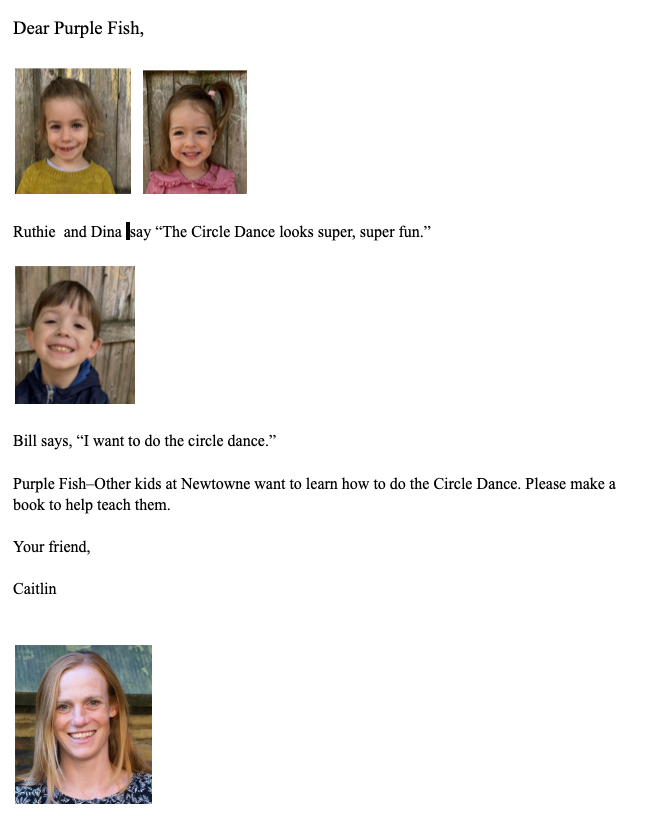
Studio time that week was devoted to making the book. Here is Daphne’s drawing of her and the other Purple Fish doing the dance:
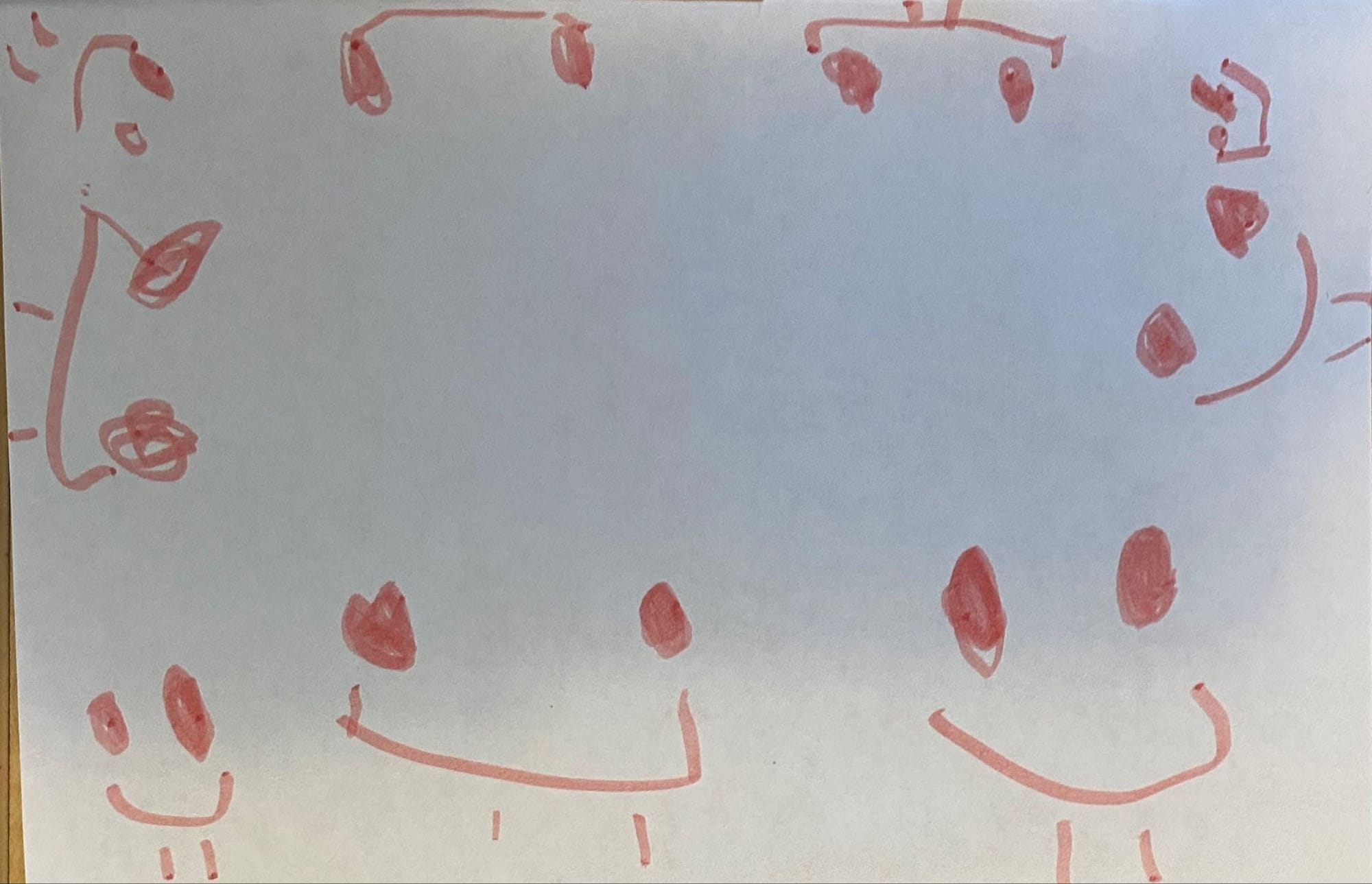
Lots of happy people in a circle.
Small groups of Purple Fish brought copies of their book to the other classes. Visiting the Orange Sea Stars (the youngest group), Teresa beat the drum as Clara and I helped the Sea Stars form a circle and try out the dance.
Two months passed and then, at the All School Fieldtrip the Purple Fish, along with the rest of the school participated in the Circle Dance. During the days after the All School Field Trip small groups of Purple Fish came to the Studio. We watched a minute of a video of the performance and I asked the children what they thought:
- We are saying thank you to the earth (Nova).
- He [Annawon] gave us the circle (Nolawi)
- He taught us the Circle Dance and woo, woo like this (Adriana)
Other children included the Circle Dance in stories they told during their Studio time:
One day there was a picture of Annawon. Know why there was a picture of Annawon? Because I wanted to hug him. The end.
Zoey
There was Annawon. All of the Purple Fish and Blue Otters and Green Dragonflies and moms and dads. They talked and talked and talked. The end.
Liran
And it was not just the children that the Circle Dance left an impression on. The day after the All School Fieldtrip Blue Otter teacher Jen Schreiner stopped by the studio and commented, “That was really cool yesterday, us all being together as a community and expressing our gratitude." I agree—it was really really cool.
The herring run
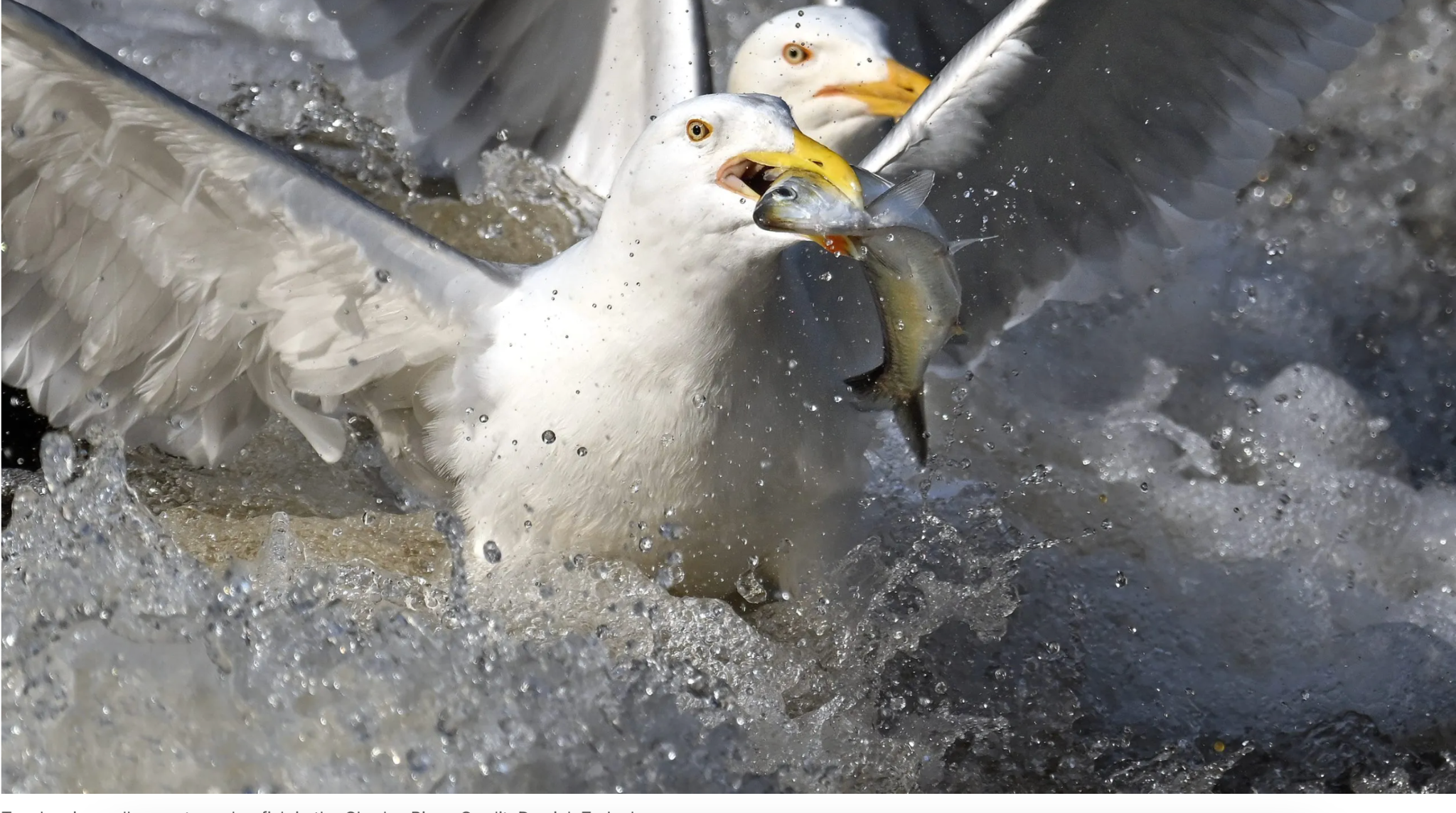
One Friday evening in May I received a text from Purple Fish teacher Jenna. It read, “The herring are running.” I rushed over to the Watertown Dam on the Charles River, a ten minute drive from my house. There I saw a host of seagulls swarming the water as silver fish leapt into the air in their attempt to find their way upstream.
For several months, Annawon had been telling us about the annual herring run. The fish return from the ocean and travel up New England rivers to spawn. The event is an important part of the Wampanoug calendar. Historically, the herring were an important food source and also used to fertilize crops. Early colonists described the fish as so numerous that one could walk across the river on their backs. Although dams and pollution have greatly diminished their numbers, what I saw that evening was still impressive.
Living in Cambridge for almost forty years, I have crossed over and driven alongside the Charles River countless times, yet I never thought of the river as a place to observe the natural world. After watching the herring run that evening, I have been back several times. I have enjoyed the numerous birds that flock there and have a growing appreciation of the river’s place in the local ecosystem. My relationship with the river has changed. Thank you, Annawon.
My negative image of the Charles had been shaped by stories I heard when I first moved to the area. Back then, because of industrial dumping, raw sewage discharge, and runoffs during storms, the Charles was one of the most polluted urban rivers in the world. There was even a song, Dirty Water, whose title summed up the state of the river.
Today the water quality of the river has improved, the result of decades of significant advocacy and action. Stewards of the river have worked tirelessly. They have worked with and taken inspiration from the Wapangoug and other local Native American tribes. They have organized clean up days and successfully lobbied local, state and federal agencies. Through these efforts it is now even safe to swim in the river. Some of the time.
Lionel’s dad has written about how, because of an antiquated sewer system, fecal matter finds its way into the river after heavy rains, fouling the water and making it unsafe for people and wildlife. There is still work to be done. For this work to be done, we need people who will share their time and talent to continue the advocacy and clean-up work. We need a citizenry who cares about the River so that tax dollars will go towards its protection. We need people who care.
Expanding the circle of care
Raising children who care, who as adults will live lives that contribute to a kinder, more sustainable, and equitable world, is the central mission of Newtowne School. While children have an innate ability to care, through the relationships we promote, teachers and families are socializing the young into who to care about. The goal of bringing Annawon to Newtowne is to help in our efforts to raise children who will care about all our relatives, human and non-human alike. Annawon coming to Newtowne School has created a new set of relationships and expanded our circle of care.
The Purple Fish have another, trusted adult in their lives. They got to know Annawon by listening to his stories, dancing with him, and exploring the artifacts he brought in. And they got to know him by having lunch together, learning about what he eats and sharing stories about their respective families.
It is significant that the children formed this caring relationship with a member of the Wampanoag Tribe. The Purple Fish teachers and I were curious about whether the children would have any stereotypical images of Native Americans. It was clear from their intersections with Annawon that, at three-years-old, the Purple Fish do not. And they will encounter disparaging images of Native Americans. When they do, their relationship with Annawon will provide important counter information. In a forthcoming essay Amy Rothschild describes how she responded when her slightly older preschoolers displayed stereotypical play regarding Native Americans. It is a complicated and important issue to consider.
Then there is the children’s relationship with the rest of nature; what Annawon describes as, “all of our relatives.” That we are related with the rest of nature is, in fact, in line with the evolutionary evidence. We all share great-great-great-great-great- (add a half million greats) grandparents with gorillas. Go further back and we have common ancestors with other mammals, birds, and even plants and mushrooms. You can think of this “Tree of Life” as our family tree.
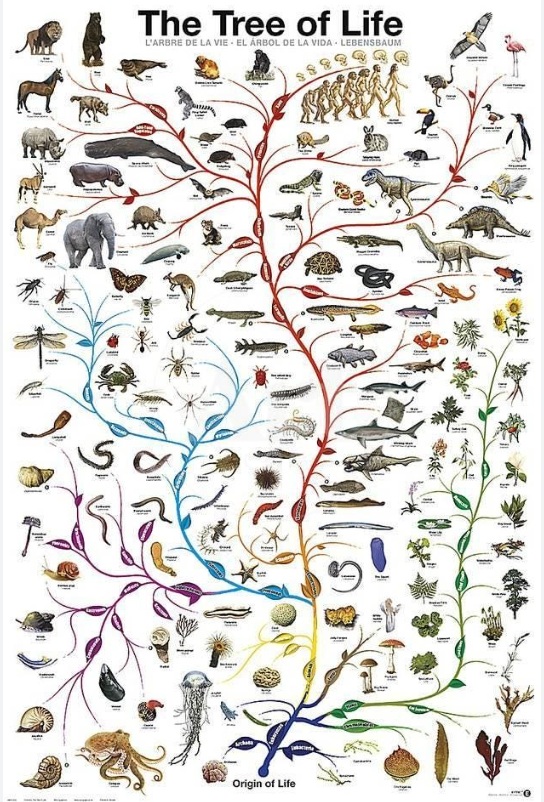
Annawon’s stories and dances highlighted our relationships with the rest of nature. The way he talks about “all our relatives” is a child-friendly way of explaining the connections between people and other critters.
Then there is the specific relationship forged with turtles. In learning where turtles live and how they move, imagining what it would be like to be a turtle, and visiting them not far from our school, the Purple Fish made friends with another species. My hope is that when they are in positions to make decisions about matters that will impact the turtles' well-being – such as the health of the Charles River – the Purple Fish will remember what it is like to be a turtle.
Annawon will be back at Newtowne this school year. Our plans are to expand the number of classrooms he works with. I am excited to see our circle of care grow.
The last Circle Dance of the year
Owen came to the Studio on the Purple Fish’s very last day before the end of the school year. During his visit he told the following story:
Annawon is right here. And Ben is here. And all the people. They are holding hands. They turn around right and left.
When we returned to the classroom, the children acted out his story. Unlike the session in March when Annawon introduced the dance to them, the Purple Fish did the dance on their own. They circled, first to the left and then to right. At the end of the story, I asked the children if they wanted to go into the middle. Without answering, the circle collapsed. Children called out “woo, woo” and laughed.
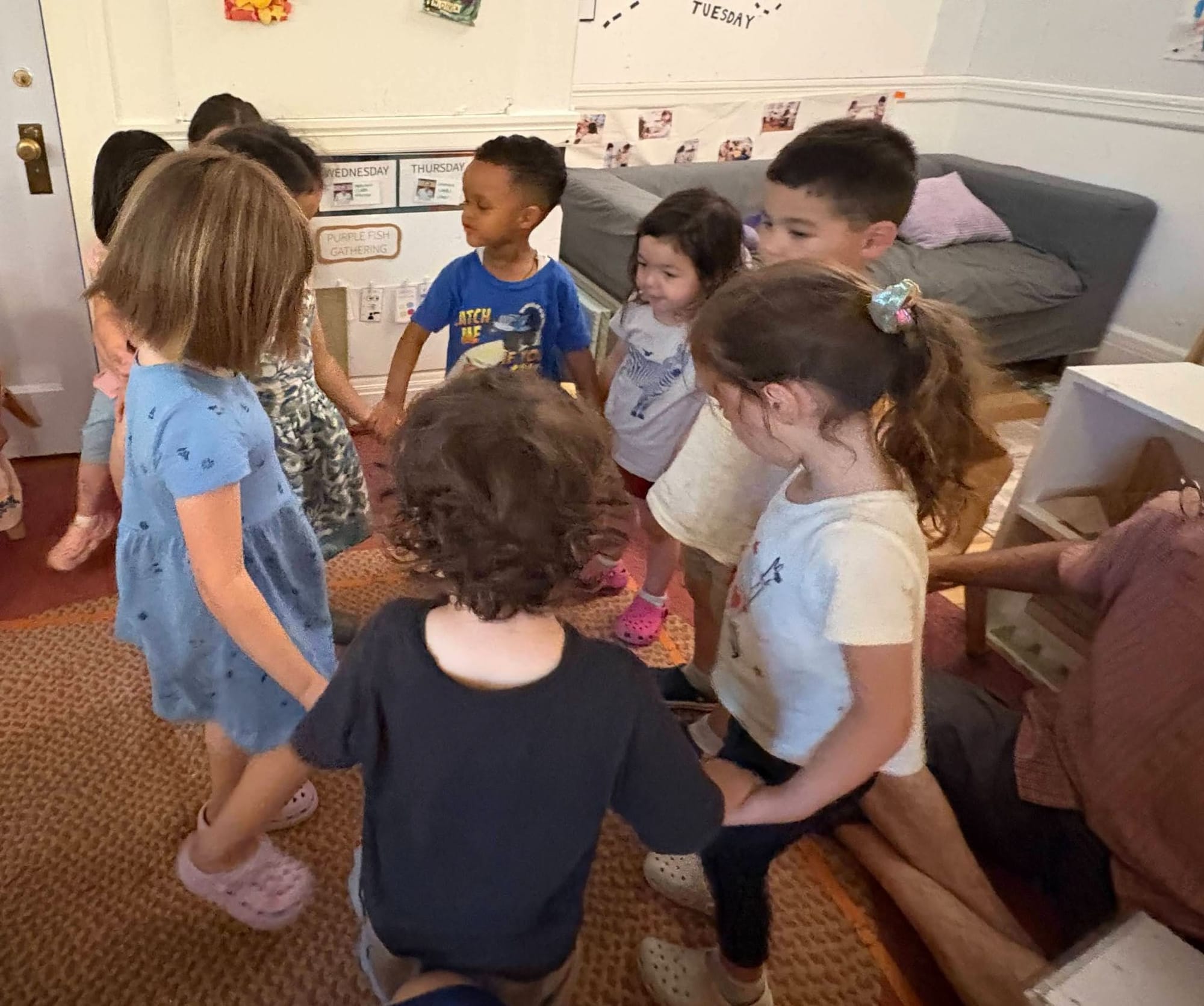
As Daphne explained, “In the middle is where the friends are.”
Annawon’s work at Newtowne was supported by grants from BARIN (the Boston Area Reggio Inspired Network) and Boston College’s Transformative Education Lab. Much gratitude to Caitlin for helping Newtowne secure these grants and her encouragement in the search to find a Native American educator for us to partner with. When things looked bleak, she helped me not throw in the towel.
Much appreciation to the Purple Fish teachers. It was loads of fun working on this project together. To Annawon, for sharing his knowledge and care with the Newtowne community.
Caitlin Malloy and Liz Merrill provided their usual and helpful editorial assistance.