Something to Think Through Together: Catalyzing Group Reflection for Playful Educators
How can playful educators catalyze group reflection to deepen the practice of facilitating children's playful learning experiences.
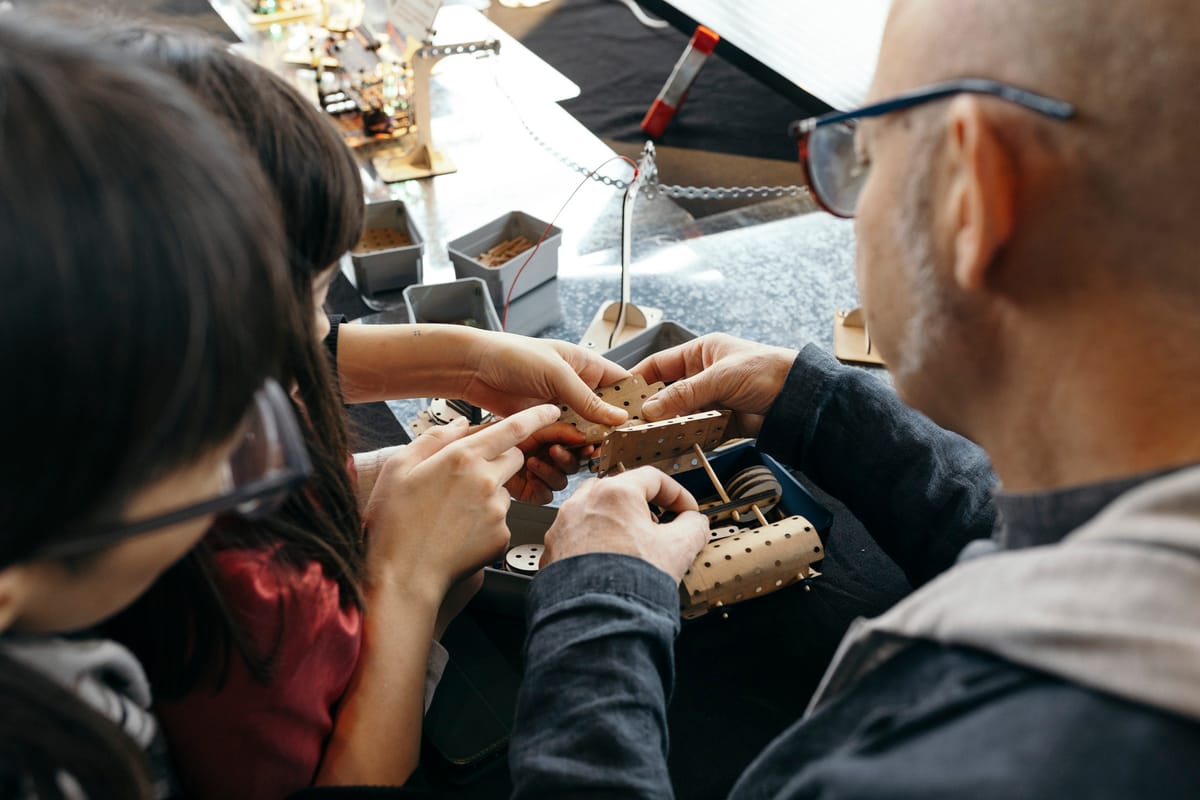
When a child sits down with a pile of bricks, they enter into a conversation with what they are making. They fit two bricks together, pause, and look. Does the tower stand? Does that look like the wing of a dragon or the wall of a castle? Based on what they see, they imagine the next step, reach for another brick, and test it again.
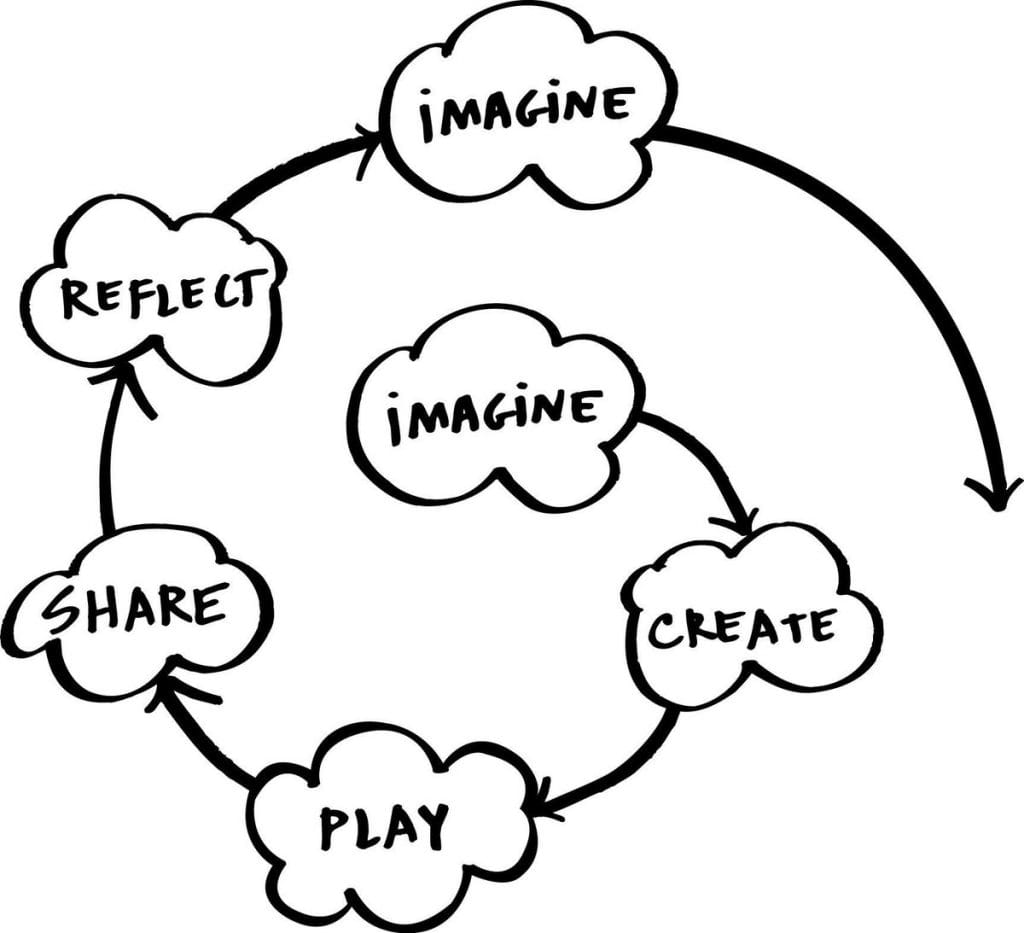
This is what Mitch Resnick calls the Creative Learning Spiral. The magic of this spiral isn't that children have a grand blueprint in their heads before they start. It's that they are in an active feedback relationship with something real, something concrete. The materials they're working with talk back to them. Like any good conversation, it provokes new questions and new ideas that the child could never have anticipated before placing that first brick. They build, they observe, they reflect and maybe even show someone what they built, and then they build some more. Learning and creativity are emergent properties of that feedback loop that we can see with our own eyes.
How People in "Scenes" Think Together
Communities of practice - from musicians in a music scene to an engineering team solving a problem - work in a similar way, only the feedback loop runs through a group of people instead of a single mind. To learn and develop, they need something to reflect and iterate on that everyone can experience first-hand. In a folk music "scene," this might be a song everyone can listen to; in short fiction, a story everyone can read; in an intellectual scene, a seminal essay. When I was helping run the Scratch online community, a website where children could make and share programs made with the Scratch programming language, the Scratch project served this role: it was the thing that kids and mentors alike made, shared, responded to, reflected on and remixed together.
Brian Eno coined the term Scenius to describe this collective intelligence of an art or music scene. Breakthroughs emerge not only from lone geniuses, but from lively networks of practitioners sharing ideas, feedback, and developing a shared and ever evolving working vocabulary. In his work at Newtowne, Ben has experimented with how to create the conditions for children to get good ideas from good ideas. What can we learn from the research on how communities of enthusiasts nurture innovation?
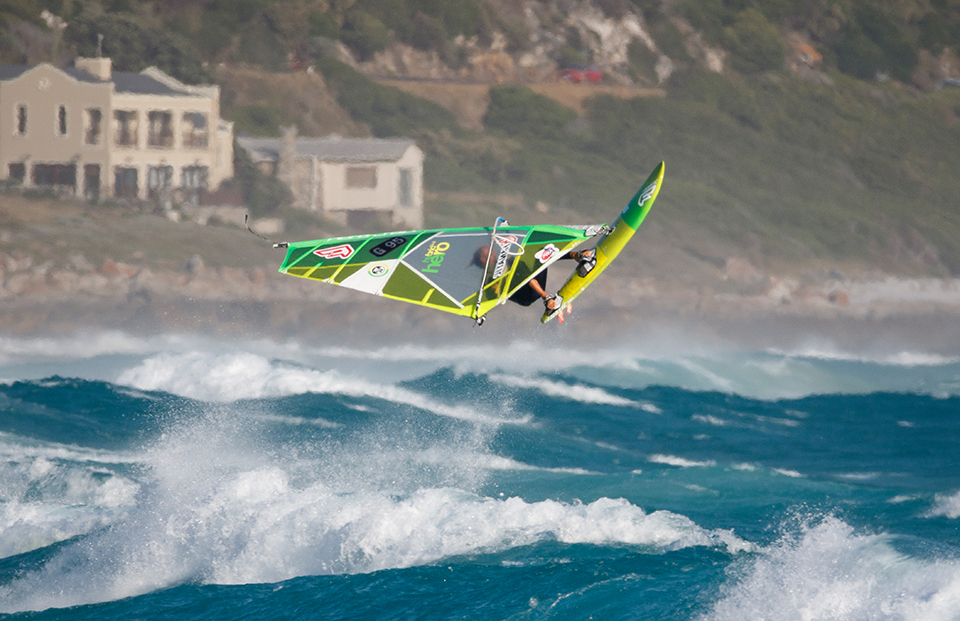
One of my favorite examples of Scenius at work comes from the windsurfing community. In 1978, Jürgen Honscheid visited Hawaii for the first time and got excited about jumping waves - something locals Mike Horgan and Larry Stanley had been tinkering with for a few years. The new enthusiasm was contagious: suddenly everyone was experimenting with jumping higher and higher. But there was a problem - riders kept flying off their boards mid-air, hurting feet, legs, and boards alike. Stanley remembered "the Chip," a small experimental board with footstraps lying around the workshop from an earlier experiment, and tried jumping with it. Suddenly he could fly, land, and even change direction mid-air. Within days, boards with footstraps of every kind appeared in the small community of sailors who'd been watching - and it snowballed. As Stanley put it: "The whole sport of high-performance windsurfing really started from that." (Shah 2000, in von Hippel 2005)
Notice what actually spread through that little "scene." Not just ideas or theories, but something concrete that everyone could see with their own eyes, try for themselves, and talk about together. And while it's Stanley who has the light bulb moment with the foot straps, the light bulb got its electricity from another community member's excitement about jumping.
Over time, the shared artifacts of a scene become a shared language for exploring new possibilities. Musicians point to a specific song that transformed how they understood chord progressions or rhythm; writers cite a short story that broke the rules of point-of-view; academics reference a seminal study: "It's like that paper by so-and-so." The shared language these artifacts anchor is what lets the network imagine what to make next. As with the windsurfers, sometimes a new innovation will be the result of a newcomer's enthusiasm inspiring an old hand to re-purpose an older prototype or idea. When it works, the rest of the community will be ready adopt and build on it.
A shared artifact, in other words, is simply something for a community of enthusiasts to think through, together.
What Do Playful Educators Have to Share with One Another?
If a surfer can share a new board or a new move, and a songwriter can share a song, and a programmer can share a program, what does an educator interested in playful learning have to share with their peers? And what would a group of playful educators be interested in looking at together?
Facilitating playful learning is an art, one that is situated, fleeting, and immensely complex. Good play facilitation has more in common with comedy improv than engineering. It happens in the present moment.
It all depends on the rich context of learners in community together: the specific children in the room, their cultural backgrounds, the physical layout of the tables, the noise level, the subtle micro-interactions between the facilitator and the learners, the delicate relationship they've established—I could go on, but you get the point. Play facilitation is far more entangled and complex than delivering lectures. But the entanglement and complexity is what makes it so exciting. Like good teaching, counseling, and facilitating communities of practice, it's more art than science (Sorry - I know that makes finding funding more difficult, but that's just the way things are in this work. :)
Playful experiences are not self-recording. If an educator in Aarhus runs a marble run on Tuesday, and an educator in Warsaw runs one on Thursday, we have no direct window into what actually happened in either space. What invited the reluctant child at the edge of the room to step forward? What caused the sudden collapse of engagement at table three? If they loved it, why did they love it?
Without something concrete to look at together - some form of documentary evidence - educators are left trading vague generalities: "It went really well!" or "The kids had fun."
But you cannot build the art of play facilitation on generalities.
I felt the importance of this when I trained as a counselor. Learning the craft involved sitting in a room with a real person, talking about their real feelings, with a camera recording it all. In weekly group supervision each student chose a clip - maybe a minute or two of an interaction - that they had questions about. We'd show it to the group and reflect on what we saw together with an experienced clinician. As the training went on I began to recognize the importance of the video clip in keeping the conversation grounded. Without it, we were awash in theory and abstraction, with nothing to check it against. With it, an interpretation either proved itself through something you could see in the video, or it didn't. We didn't always come to the exact same conclusions about what we were seeing. But that's good, because that would be a very weak form of collective intelligence.
Looking back, I think what made those sessions so helpful in learning how to be a counselor was that the clips gave all of us in the room the same small thing to think through together - and the differences in how we saw it were where the learning happened.
Pedagogical Documentation
Decades ago, educators in Reggio Emilia, Italy, recognized that if a group of teachers were going to develop a deeper understanding of children's learning, they could not rely on talk and memory alone. So they developed the practice of Pedagogical Documentation.
As Krechevsky and colleagues at Project Zero defined it, documentation is "the practice of observing, recording, interpreting and sharing through a variety of media the processes and products of learning in order to deepen and extend learning" (Krechevsky et al., 2013).
Instead of treating learning as an invisible, private event or reducing it to a standardized test score, Reggio educators began capturing small, rich fragments of classroom life: photographs, transcripts of children's dialogue, sketches, and artifacts of work in progress. They would take the time to reflect on what they saw and form an interpretation, and then present it to their colleagues and supervisors to hear their impressions and test their ideas. In Reggio Emilia, this practice of reflective documentation drives the development of the teacher and the quality of the work they do.
The Classic Touchstone: Laura and the Watch
A classic example of Reggio's Documentation practice comes from The Diary of Laura: Perspectives on a Reggio Emilia Diary (Edwards & Rinaldi, eds., Redleaf Press), a book built around the documentation of a single toddler's experience in an early childhood center..
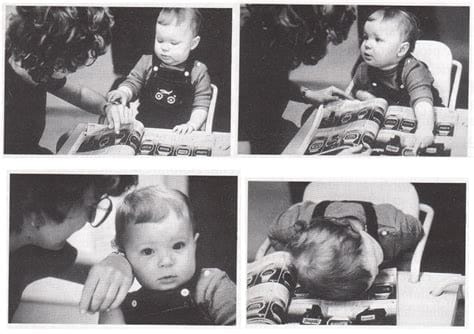
In the four panels above, Laura notices her teacher's watch, and then makes the connection to the images of watches in the magazine. Her teacher holds her watch to Laura's ear so she can hear it ticking. Laura makes a hypothesis: If this one ticks, maybe the watches on the page tick too? She decides to test her hypothesis.
When educators gather around a piece of documentation like Laura and the Watch, they aren't looking at a bureaucratic report or a polished promotional brochure. They are looking at a concrete trace of learning—making the invisible process of meaning-making visible. They can discuss: What sparked Laura's curiosity? How did the educator's decision to show Laura her watch change her investigation? What could or should be offered next, and why?
The documentation becomes something the community of educators can think through together. Its concreteness makes it possible for the group to construct a shared, abstract language about the work.
Spreading the Practice—and Hitting the Real-World Wall
Over the past two decades, researchers and educators have worked to adapt Reggio's insights to new settings. Projects like Harvard Project Zero's Pedagogy of Play—led by Ben Mardell and colleagues working with schools like the International School of Billund—have demonstrated how reflective documentation can support playful teaching and learning across elementary and early childhood classrooms. I've introduced the practice of Documentation to librarians interested in facilitating playful learning experiences.
But as anyone who has tried to introduce pedagogical documentation to a new context knows, it's easy to run headfirst into steep institutional hurdles:
- Time Scarcity: Gathering, transcribing, selecting, and laying out documentation panels takes time— something frontline educators and librarians tend to have very little of. Our society seems to have come to the (disastrous, in my opinion) conclusion that reflection is for academics, not educators.
- The Metric Fixation: Public institutions are obsessed with quantifiable outputs and neat checklists, leaving little official space for open-ended reflection. When evaluation measures dominate, Goodhart's Law takes over: the metric ceases to be a good measure and instead crowds out authentic, exploratory practice.
- The "Play Is Easy" Trap: Outside observers often assume play is natural and effortless, and therefore facilitating or designing for it must be easy. It isn't. Asking for dedicated staff hours just to "reflect on play" can feel like an impossible sell to administrators.
Yet we absolutely need networks of educators with time to reflect together in order to develop the craft of playful learning facilitation and design.
Designing a Radically Simplified Shared Artifact
What form of documentation could we design that is simple and low-friction enough that a busy librarian running a play workshop on a Tuesday can assemble it in 15 minutes using just their smartphone? To be honest, I don't know. But I can try to frame what a solution might look like.
To work in the real world as it is today, this shared artifact needs to satisfy three basic constraints:
- Easy to capture in the room: The educator must be able to snap what they need on a phone without dropping their facilitation role.
- Built for reflection: It shouldn't just record what happened; it should provoke the educator to reflect on why it happened and what they were trying to explore. It should be a vehicle driven by the educator's curiosity and passion for her work.
- Bite-sized for peers: Like a song, the artifact must be digestible by colleagues in under five minutes, even if it sparks an hour of rich discussion and weeks of reflection afterwards.
The 3-Slide "Show and Tell" Model
This is an unsolved and genuinely complex challenge. True to the learning spiral, rather than waiting for a perfect theoretical answer, I'll propose a concrete place to start so we can try it, reflect on it, and see what happens.
Here is a small ritual designed to give a distributed network of playful educators something to think through together: Three slides, two photographs, and one question.
Slide 1: Curiosity
- Include a photo that shows how you set the scene for your playful activity.
- Introduce what you did with "Setting up this activity, I was curious about..."
Slide 2: A Thing that Happened
- Include a photo or brief video that shows or at least helps you to explain something that happened that made you wonder.
- i.e. "A girl who was curious came up and asked me .... " or "I could see a child was struggling with ..."
Slide 3: A Question
- Optionally include a photo that's relevant to the reflection
- "What this made me wonder about was..."
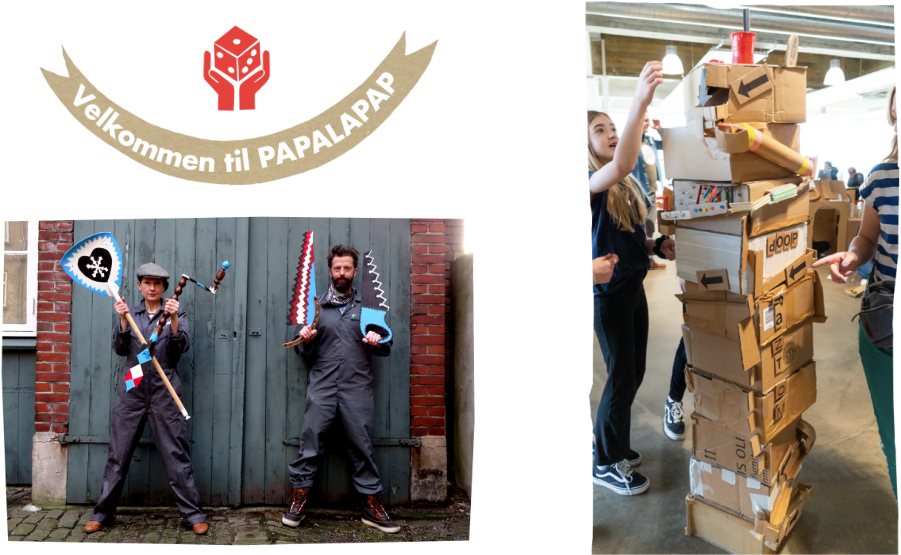
To give an example, here are three "slides" based on a cardboard construction workshop called Papalapap that was designed by the wonderful Secret Club. To make it I used photographs and observations collected by colleagues at Aarhus Public Libraries during our collaboration.
Slide 1 — Curiosity. Papalapap involves, among other things, building marble runs out of cardboard boxes. Running this activity, I was curious what would happen when parents built alongside their kids instead of watching from the sidelines.
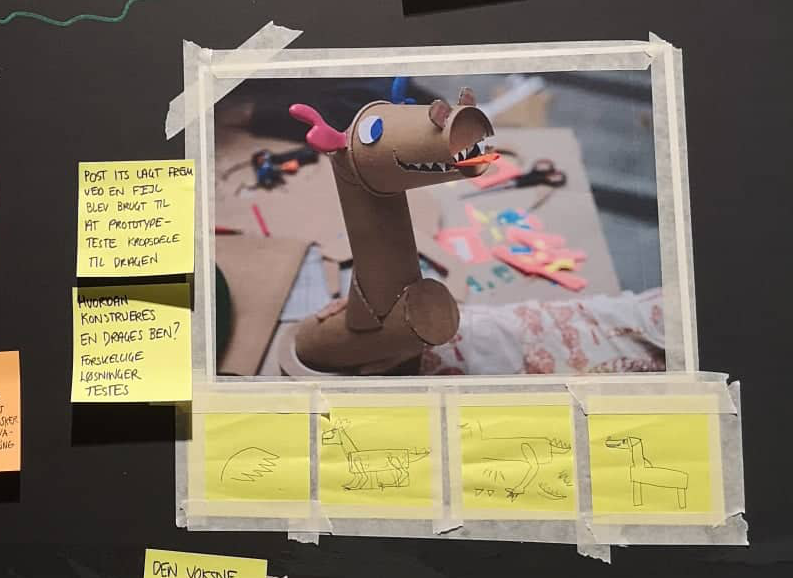
Slide 2 — A Thing That Happened. One kid started building a dragon. She wasn't sure how to make the legs so she asked her parents for advice. They suggested she sketch out different designs on post-it notes, and then choose whichever one she liked best.
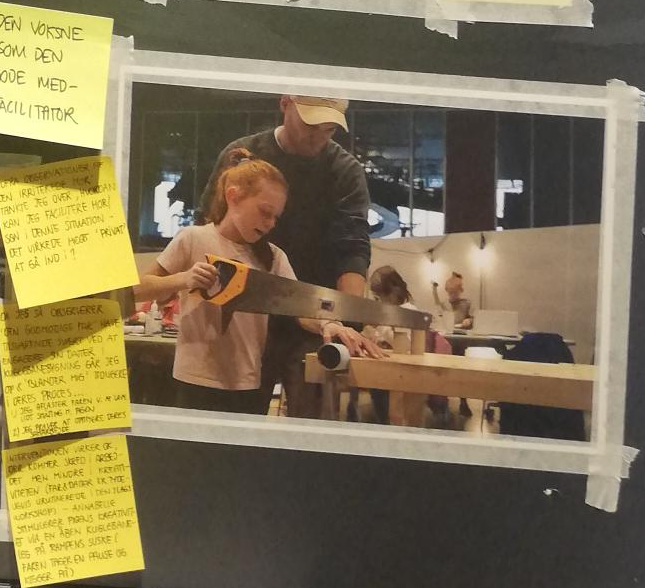
Slide 3 — Question. What can we learn from watching parents facilitate creative play with their kids? What kind of help supports children's play, and what kind doesn't?
The slides take fifteen minutes to make and five minutes to present - and they give the group something concrete to look at, reflect on, and wonder about together. What would you focus on if you were asked to create three slides about your own work, and who would you share them with? Try it and see what grows out of the conversation.
Closing the Loop: Cultivating "Scenius"
When playful educators gather (online or in person) and share concrete documentation of their work with their peers, something remarkable happens. Even if we can't know in advance precisely what that will be, we can trust to our experience: interesting patterns will be recognized, and new questions and new possibilities will arise. It's this kind of sustained attention that leads communities of practice to new discoveries and new ways of doing and thinking about their work. From what I've seen of collective creativity, this dialogue between the concrete objects or records of experience and the abstract ideas rooted in them is a crucial engine of innovation.
Perhaps this is how a solitary practice turns into collective intelligence, and how a playful learning "scene" - and "Scenius" - is born.
In the end, this proposal amounts to something very simple: finding better ways to give a group something to think through together. The slides, the photos, and the initial questions aren't the destination, they're the catalyst. Once a group has a concrete moment of playful facilitation on the table, the reflection, the shared language, and the evolution of their practice will follow.
References
- Krechevsky, M., Mardell, B., Rivard, M., & Wilson, D. (2013). Visible Learners: Promoting Reggio-Inspired Approaches in All Schools. Jossey-Bass.
- Edwards, C., & Rinaldi, C. (Eds.). The Diary of Laura: Perspectives on a Reggio Emilia Diary. Redleaf Press. ISBN 978-1-60554-152-5.
- Shah, A. (2000), as quoted in von Hippel, E. (2005). Democratizing Innovation. MIT Press. Story retold in Blanton, A., EER: Collective Creativity in the Library (PhD dissertation).