
Special Critter Friends
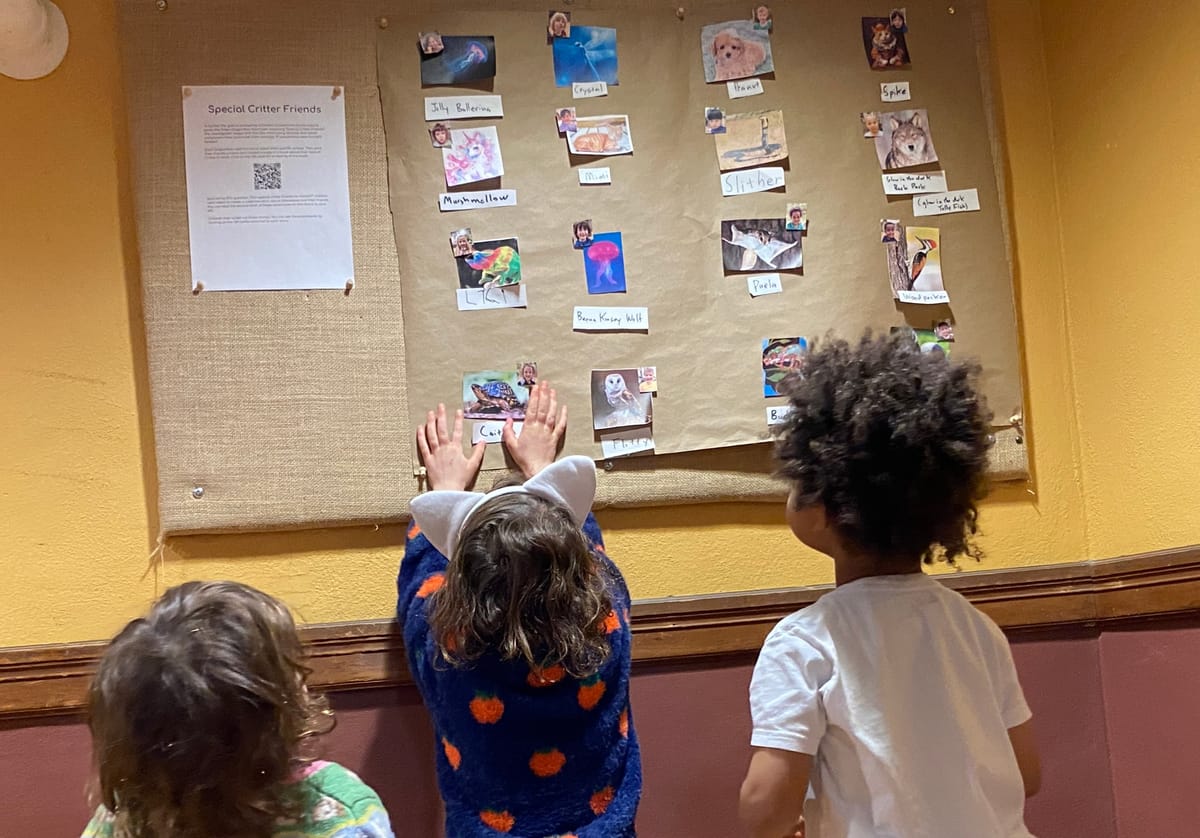
This essay describes the start of the Special Critter Friends project which aspires to foster four and five-year-olds' solidarity with nature by creating a bond between children and particular animals.
“I wish Bucksaw was real”
In late February, walking with Wole past the poster of his and his Green Dragonfly classmates’ Special Critter Friends, he tells me, “I wish Bucksaw was real.” Bucksaw, a chameleon, is Wole’s Special Critter Friend. According to Wole:
My chameleon can stick its tongue out and get some screw drivers. He blends in and hides from people and catches them. Bucksaw is so awesome.
Since January, Wole and his four-and five-year-old Green Dragonfly classmates have each selected an animal that complements them to be their Special Critter Friend. In starting this project I had in mind the daemons from Phillip Pullman’s Dark Materials trilogy. Each person in Pullman’s novels has a deep bond with their daemon, intelligent animals with unique personalities. A new endeavor, I hoped that the idea of having a special animal would connect with the Dragonflies and hypothesized that a bond with a specific animal could be a pathway to greater solidarity with the rest of nature. This essay chronicles the start of the project and considers next steps now that bonds between the children and their animals have been established.
Picking a friend
To introduce the idea of Special Critter Friends, when the children came to the studio in small groups they encountered a photo of Lyra, the protagonist of the Dark Materials story, with her daemon Pan. I explained that despite their differences (e.g., Lyra is big, Pan is small) they are friends and because of their differences they complement each other (e.g., Lyra can get things that are high up and Pan can go into small spaces).
I wanted children’s selection of their Special Critter Friend to be a considered, deliberate process. Step One of the project involved the Dragonflies creating a common pool of candidates. I told the children:
To help you find good special critters you are going to get to do research by looking through books, playing, drawing, using the ChompSaw (a child safe power tool used for cutting cardboard), and talking to your friends. At the end of our studio time you’ll get a chance to put a critter on our list. Next time you will use the list to pick a critter.
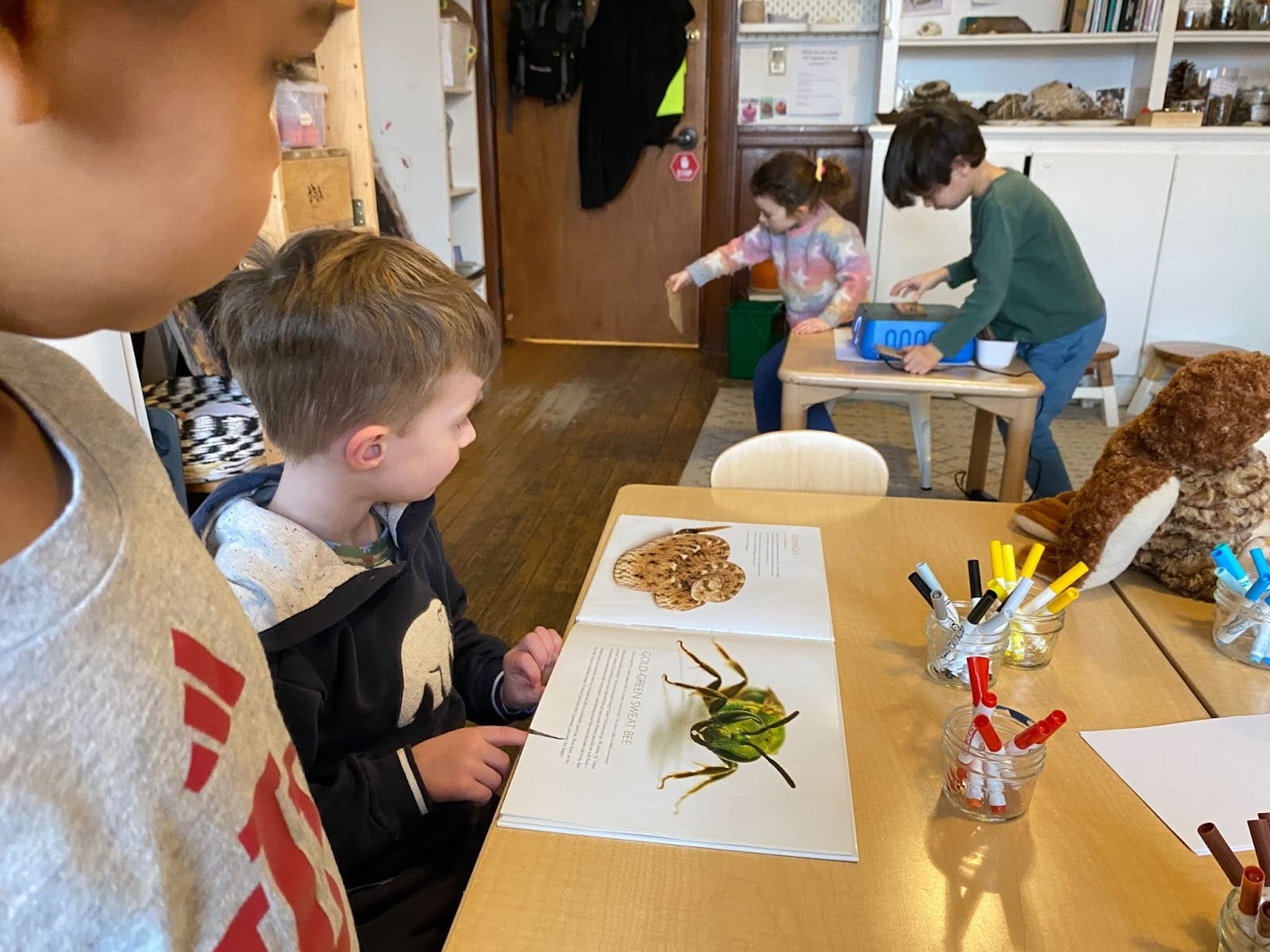
Through their research, nominees appeared. Drawing a snake led Elliot to nominate cobras. Cracking acorns with a nutcracker led Eli to nominate squirrels. Reading a book on pond animals led Finlay to suggest turtles. Playing with the studio’s collection of puppets led Nya to nominate owls. Using the ChompSaw led Nathan to nominate octopuses. In all, the Dragonflies came up with a menu of 19 possible critters. I created a poster with photos of each one.
The process continued during the children’s next studio visit. Step Two involved each child selecting an animal for their Special Critter Friend. Looking over the array of possibilities, I reminded the children of the selection criterion: an animal that would compliment them; help them do things they could not do alone.
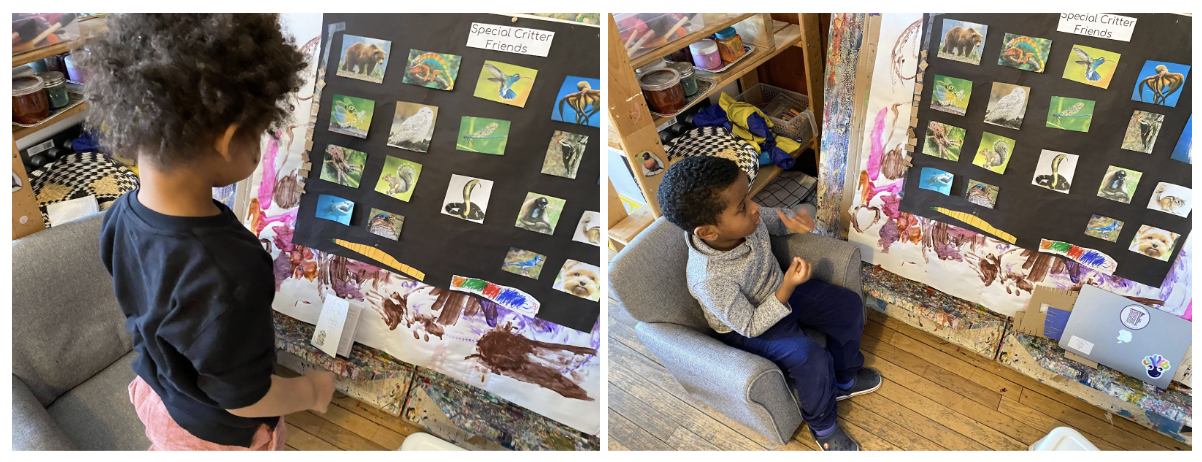
Eli’s conference was typical in that he identified more than one possibility – in this case crocodiles and squirrels. We discussed each in turn:
Ben: What can a crocodile do that you can’t?
Eli: They can swim better than me. And go underwater and I can’t swim underwater.
Ben: Maybe it could give you a ride. What about squirrels?
Eli: It can go up trees and get stuff that I want.
Ben: They also can crack open things like acorns.
Eli: Like a machete. It could crack open a coconut.
After Eli settled on squirrels we then looked at images of different species. In the end, he selected the northern flying squirrel and an image from an array of possibilities online to represent his Special Critter Friend.
By the end of the week, each of the 16 Dragonflies had selected a species: cobra, dragonfly, flying squirrel, owl, turtle, unicorn, wolf, woodpecker, along with two cats, chameleons, dogs and jellyfish. I pasted the images they chose and posted them on a bulletin board near the Dragonfly classroom. As families came and went each day children would often have their grown ups pause to view the poster, discussing not only theirs but their classmates' Special Critter Friends. The children’s investment in the Special Critter Friends convinced me to continue the project.
Our Special Critter Friends
To create a bond between each child and their friend, I felt it would be helpful for the friends to have names and attributes. Step Three of the process supported children in creating a page for a book, Our Special Critters Friends, with this information.
To provide grist for the mill, the next time the Dragonflies visited the studio we began our sessions by watching short videos about the animals the children had selected. We watched jellyfish gracefully float in the ocean, owls and flying squirrels glide through forests, and a chameleon catch insects with its tongue.
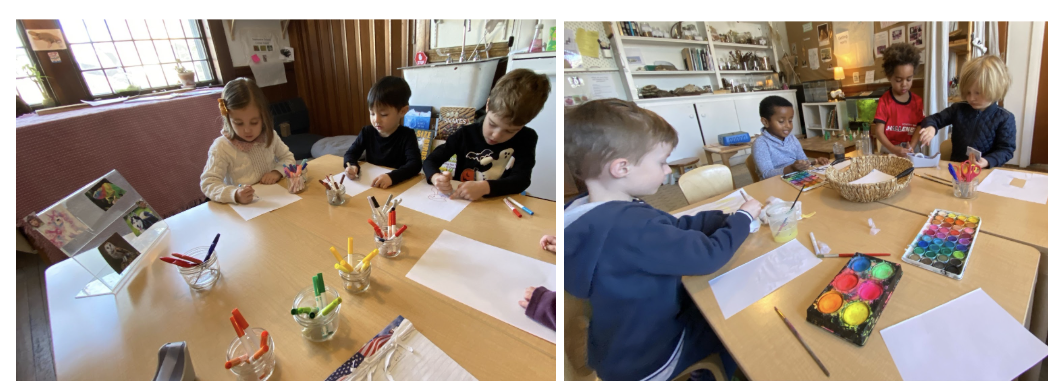
To create their pages, children were invited to play with cut-outs of the critters, use the ChompSaw, and play with puppets. They considered photographs of their species and met with me to discuss names and attributes. Here is a selection of pages from the book about Emilia’s chameleon, Noa’s jellyfish, Leo’s puppy and Phillip’s barred owl.
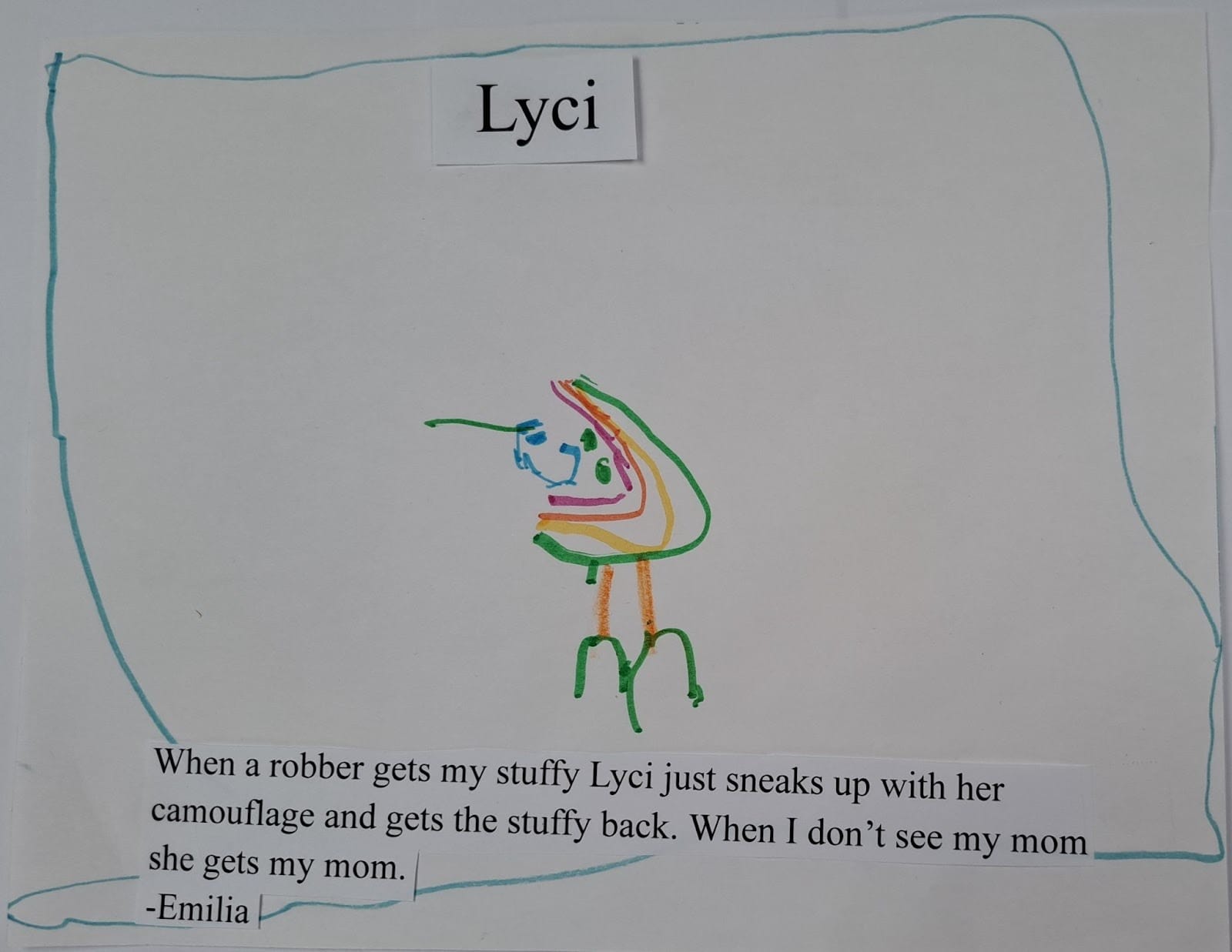
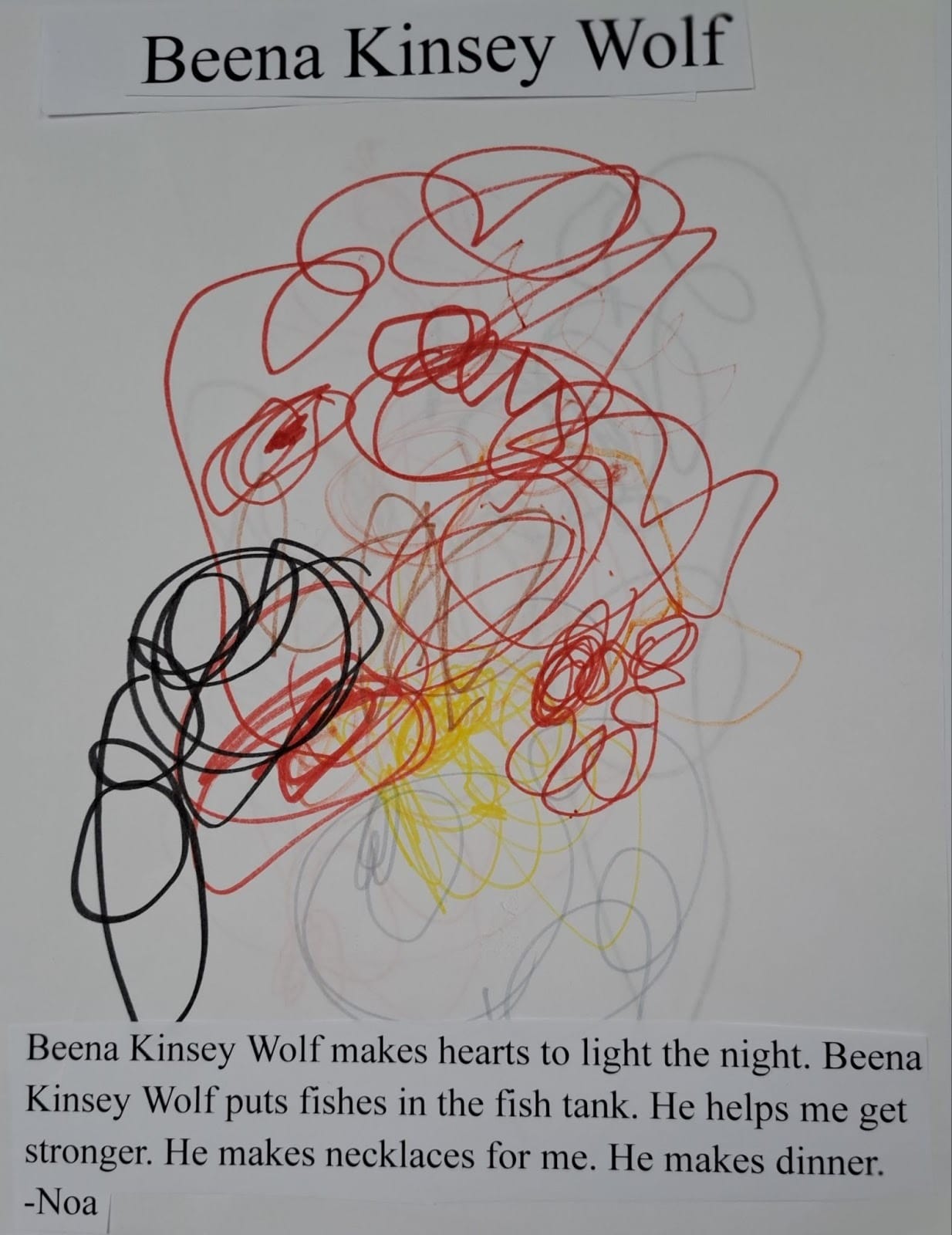
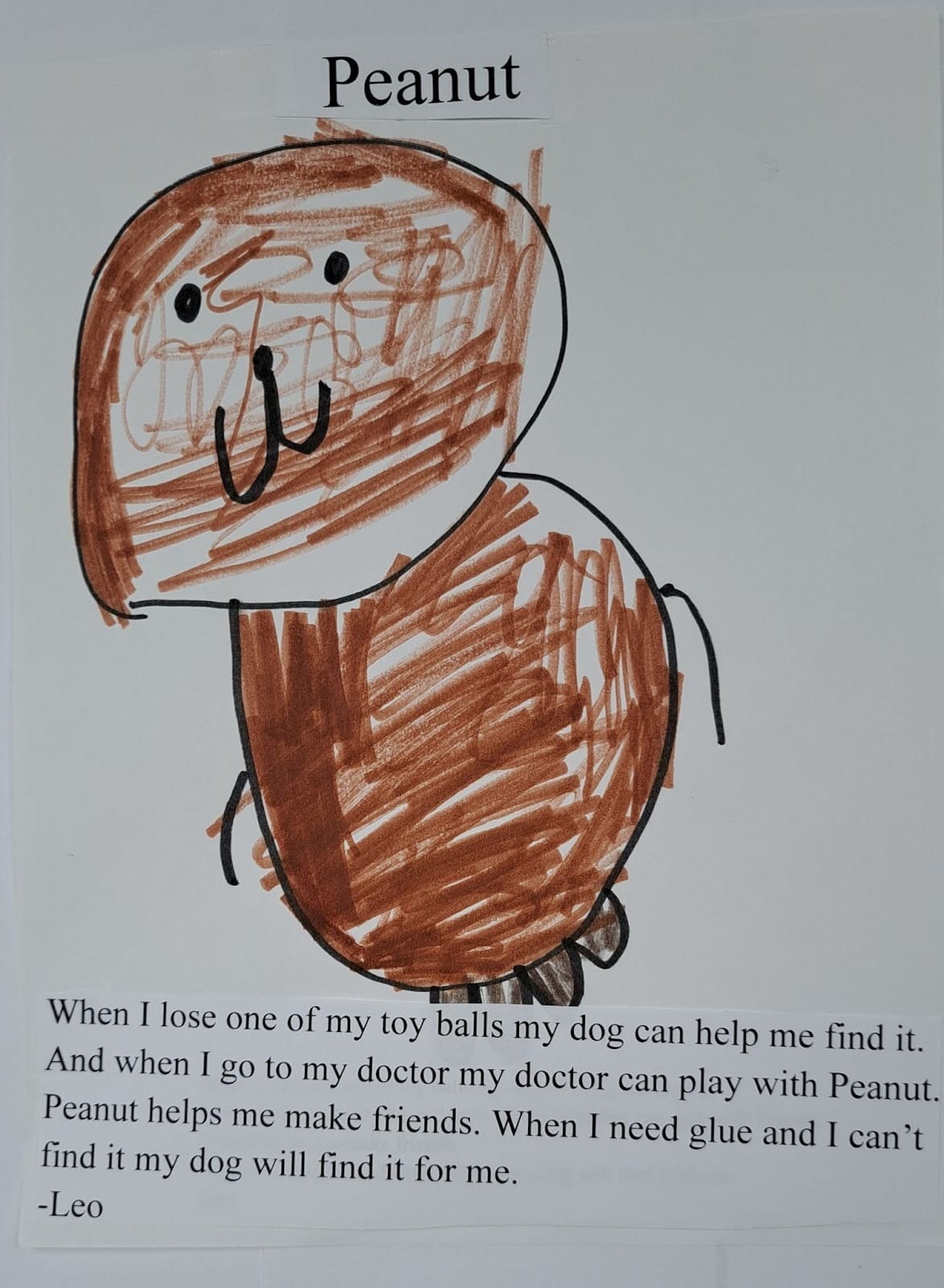
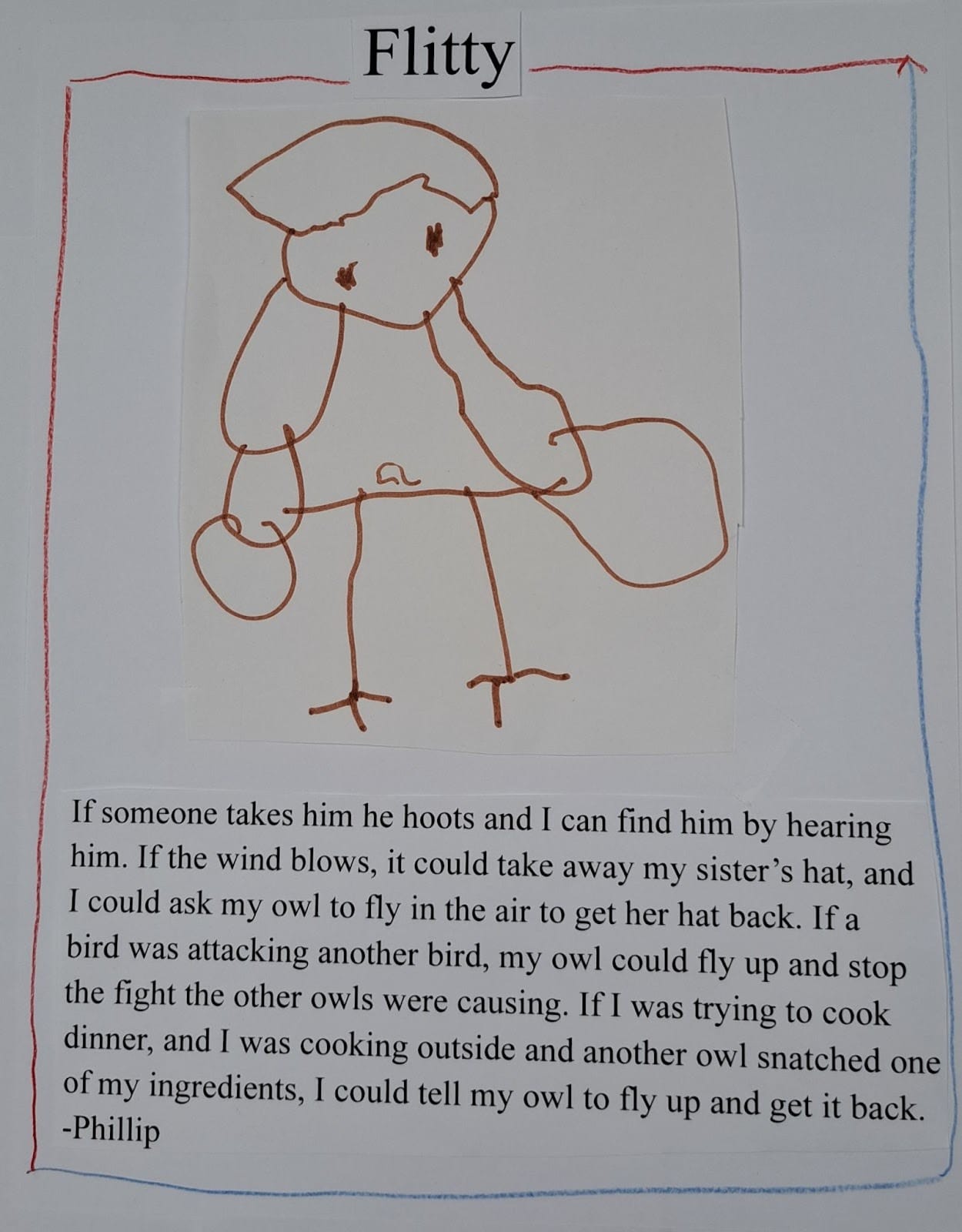
I agree with Phillip. If I was cooking outside and a critter snatched one of my ingredients, I would want a friend to get it back.
“Can Special Critter Friends be friends?”
During a book making session Eli asked, “Can Special Critter Friends be friends?” Since making connections was central to the entire project, the answer was, of course, yes. Step Four involved giving groups of children a story starter about their four Special Critter Friends facing a common problem and inviting them to continue the story. Children were again invited to draw, play with figurines of their critter friends, and use the chompsaw to uncover aspects of their story, and look through the Our Special Critter Friends book for ideas. Research completed, I transcribed the groups’ stories at the end of the studio session.
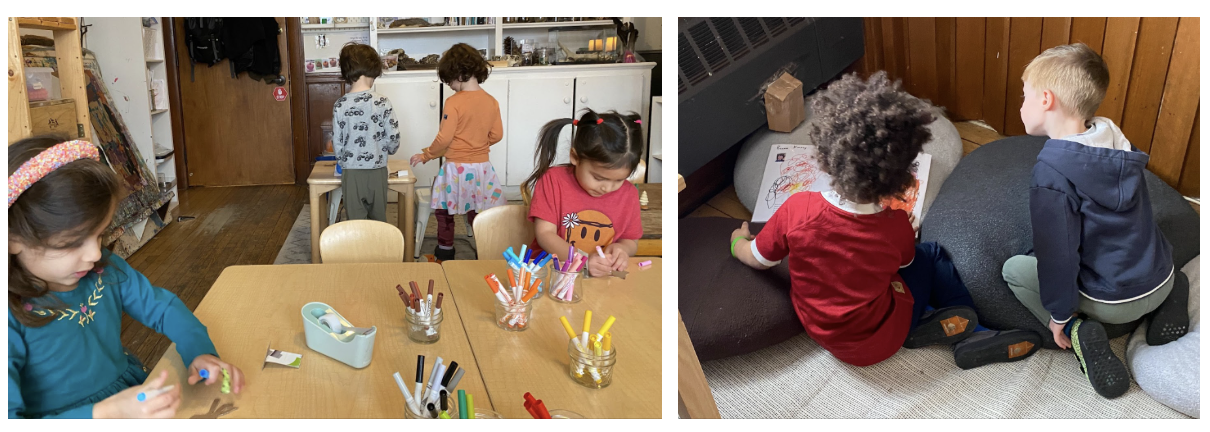
Children were engaged by the invitation and, as often happens in the first telling of stories, they left unanswered questions in their narratives. Step Four and a half: when these groups were next in the studio, I told them about Austin’s Butterfly, where a first grader gets feedback and does multiple drafts to improve his drawing of a swallowtail butterfly. I invited the groups to work on a second draft of their stories, providing some feedback. Again, the children could draw, play, and construct to uncover aspects of their stories. Parts of the narrative emerged during this play and we discussed changes in the narratives at the end of the sessions.
The story starter I gave Elliot, Finlay, Nathan, and Emilia involved the Orange Sea Stars, the youngest children at Newtowne. The Dragonflies share an outside time with the Sea Stars and enjoy helping their younger schoolmates. Here is the group’s story, beginning with the story starter. The first draft is in italics, and the children’s additions (their second draft) bolded:
Crystal, Woodpecker, Caitlin, and Lyci were having dinner. Eliot, Nathan, Finlay and Emilia had made them their favorite foods: mosquitoes for Crystal, ants and acorns for Woodpecker, worms and spinach for Caitlin, and crickets for Lyci. The special critter friends were so happy. But not for long.
Elliot, Nathan, Finlay and Emilia ran into the room and told them, “There is a big problem! Robbers have stolen the Orange Sea Stars books and taken them to an island so they can’t get them back. The Sea Stars are so sad. They need our help!”
Woodpecker said to Crystal, “I need your help.” Woodpecker got a map with x marks the spot and flew to get the robbers and get the books. Lyci used her camouflage to get the books. She helped Woodpecker. Caitlin swam and got the books. They put the robbers in the lava jail. They brought the books back to Newtowne. They brought the books back to the Orange Sea Stars. The Orange Sea Stars said, “thank you.”
They all had a picnic. There was pizza, pasta, a little sugar, pepper, cake, milk, ice cream, water and lemonade. There were presents for the Dragonflies. Getting their books back were the Sea Stars presents.
There was no more trouble. The end.
Wole, Tomo, Phillip, and Leo are obsessed with the Animal Battle Book series (titles include: Anaconda vs. Jaguar; Orchid Mantis vs. Asian Giant Hornet; and Coyote vs. Dingo). Despite my ambivalence about the series (it ignores the cooperative aspects of the animal kingdom that Darwin and other naturalists observe), I presented them with a battle-like scenario for their story starter. Not surprisingly, they found it compelling and completed the following story (again, beginning with the story starter, the first draft is in italics, and the children’s additions in their second draft bolded):
Bucksaw, Slither, Flitty, and Peanut were having dinner. Wole, Tomo, Phillip, and Leo had made them their favorite foods: crickets for Bucksaw, rat snakes for Slither, frogs for Flitty and chicken for Peanut. The special critter friends were so happy. But not for long.
Wole, Tomo, Phillip, and Leo ran in. They said, “There is a problem. There is a great white shark here at Newtowne and it wants to versus us. And the great white shark has lots of advantages– really sharp teeth and a super strong jaw. But we have strengths too.”
“It will be four against one,” said Slither. “I’m going to throw rocks with my friends Peanut, Flitty, and Slither and it will be destroyed forever,” said Bucksaw. Flitty dropped 2 rocks on the great white shark. Peanut threw a rock at the great white shark's eyeball and then it went down the great white shark’s throat. The great white shark was dead.
Then the Dragonflies and special critter friends had a picnic. Dog treats for Peanut, bugs and caterpillars for Bucksaw, a tasty rat for Slither and a bunch of cakes and peanuts for Flitty. The Dragonflies had ice cream, ravioli, spaghetti and meatballs, and chocolate bars.
Everyone went to the library to get Battle Books to read. They got all the books from the library and brought them to the picnic. And they found even more critters to be their friends.
“Even more critters to be their friends.” Exactly the direction I had hoped this project would take.
“Muzhi needs a friend”
In the midst of the project, a new student joined the Green Dragonfly classroom. Muzhi arrived from Beijing, fluent in Mandarin but with little English. With the goal of Muzhi feeling comfortable in the studio, and supporting connections to his classmates, I brought him, Tomo, and Wole to the studio for lunch.
Walking past the Special Critter Friend poster on the way Wole called out, “Muzhi needs a Special Critter Friend.” Once in the studio Tomo suggests that he and Wole draw pictures of species for Muzhi to consider, images to work around their language barrier. When finished with lunch, the duo got to work, producing eight possibilities for Muzhi, including a: Falcon, Bald Eagle, Anaconda, Octopus, Tarantula, Momba, Cheetah, and Sea Iguana.
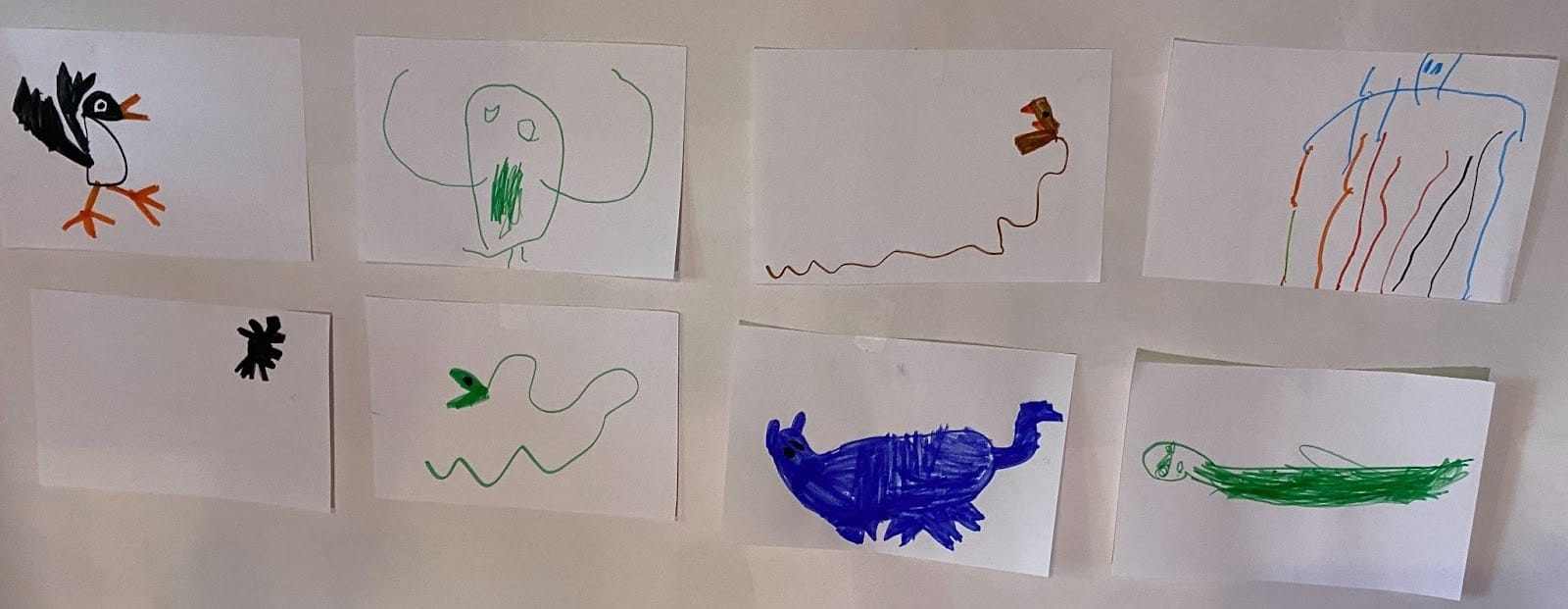
In the end, Muzhi, with the help of his mother, chose a T-Rex that he named Chocolate. The other Dragonflies immediately recognized the addition, asking about the name of Muzhi’s Special Critter Friend.
“Your Special Critter Friend is real”
In mid-March, I was walking with Emilia past the Special Critter Friend poster. She remarks, “ I wish Lyci (her chameleon Special Critter Friend) was real.” This was not the first time I was struck by how compelling the idea of having a unique animal friend was to the Dragonflies. I remembered that several Blue Otters had asked me if they could have a Special Critter Friend. I thought, there is something to this project.
And my response to Emilia was, “Your Special Critter Friend is real.” She responded:
Emilia: Marshmallow (Julia’s unicorn friend) isn’t real.
Ben: But chameleons are real.
Emilia [proudly]: They can catch insects with their tongues.
True, there is not a chameleon who gets Emilia stuff and finds her mom. Yet chameleons are real. Sadly, due to habitat loss and global warming, 38% of chameleon species are threatened with extinction.
The same is true for dragonflies, owls, turtles, and northern flying squirrels. Human caused environmental changes impact all of the earth’s critters.
After reading a draft of this essay, my friend and Remake co-editor Amos Blanton observed that with the Special Critter Friend project I was playing Loris Malaguzzi’s famous game of ping pong. Malaguzzi likens this emergent, reciprocal approach to teaching and learning as involving an adult “serve” to the children in the form of a provocation, which the children return back with their ideas. The teacher then volleys back with another, connected provocation, and so on. A sign of success here is a long and playful rally.
With this project we had the initial provocation of identifying species that could be Special Critter Friends. The rally continued with the selection and naming of specific friends. Eli's idea about Special Critter Friends being friends led to the provocation of collective storytelling.
Throughout, the children have imagined ways their Special Critter Friends can help them. Knowing that the real critters involved here are threatened by climate change, what if my next volley involved asking the children to consider ways they could help their Special Critter Friends?
Thanks to Liz Merrill, Amos Blanton, and Caitlin Malloy for their feedback about this essay Sasha’s family for introducing my family to Phillip Pullman.