
What to do when children stomp on, play with, cry about, and intervene with critters? Answer–it depends
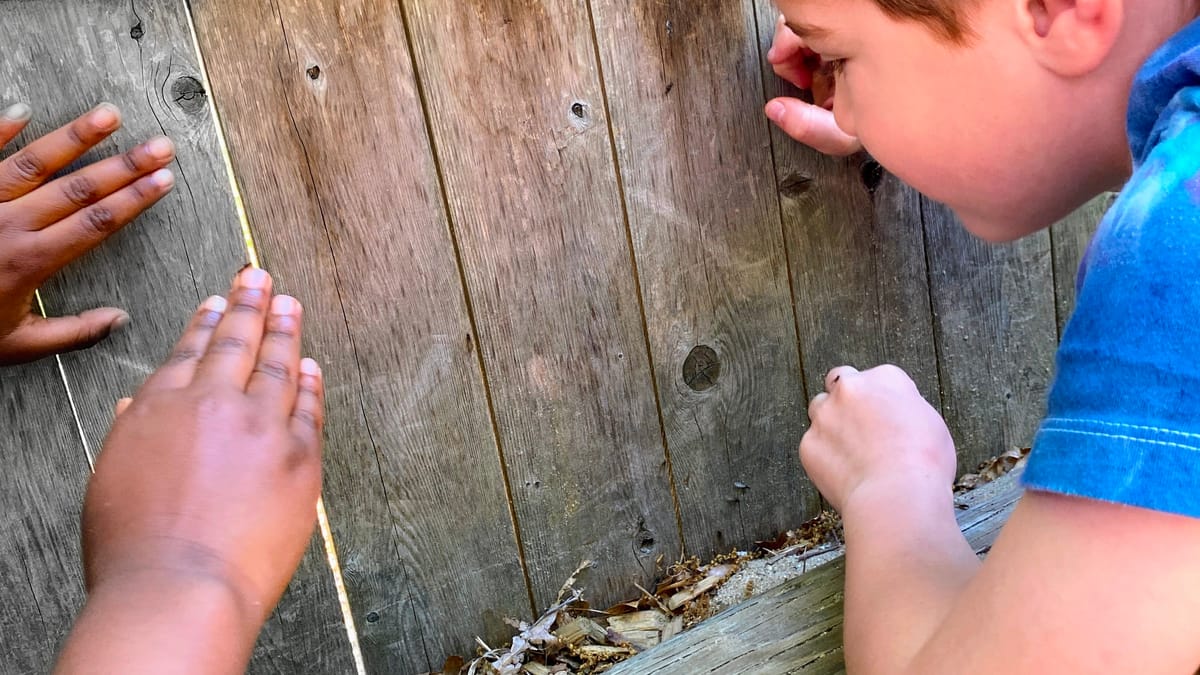
Grounded in a 20 minute episode on the playground, this essay shares the perspectives of colleagues and children to explore four teacher decision points regarding the socialization of children’s relationship with the natural world.
Every spring dozens of Eastern Subterranean Termites emerge from their underground colonies and swarm around the Newtowne playground. Part of their reproductive cycle, the termites, who have grown wings, are looking for mates. Sparrows are attracted to the playground, looking for food for fledglings back in their nests. It is a magnificent sight. The termites look like fairies as the sun hits their wings. The birds skillfully pick them out of the air. It is all part of a complex ecosystem that has been going on for hundreds of thousands of years in this part of the world, where termites – who are key in the recycling of dead wood, and now the bane of homeowners – provide essential protein for newborn birds.
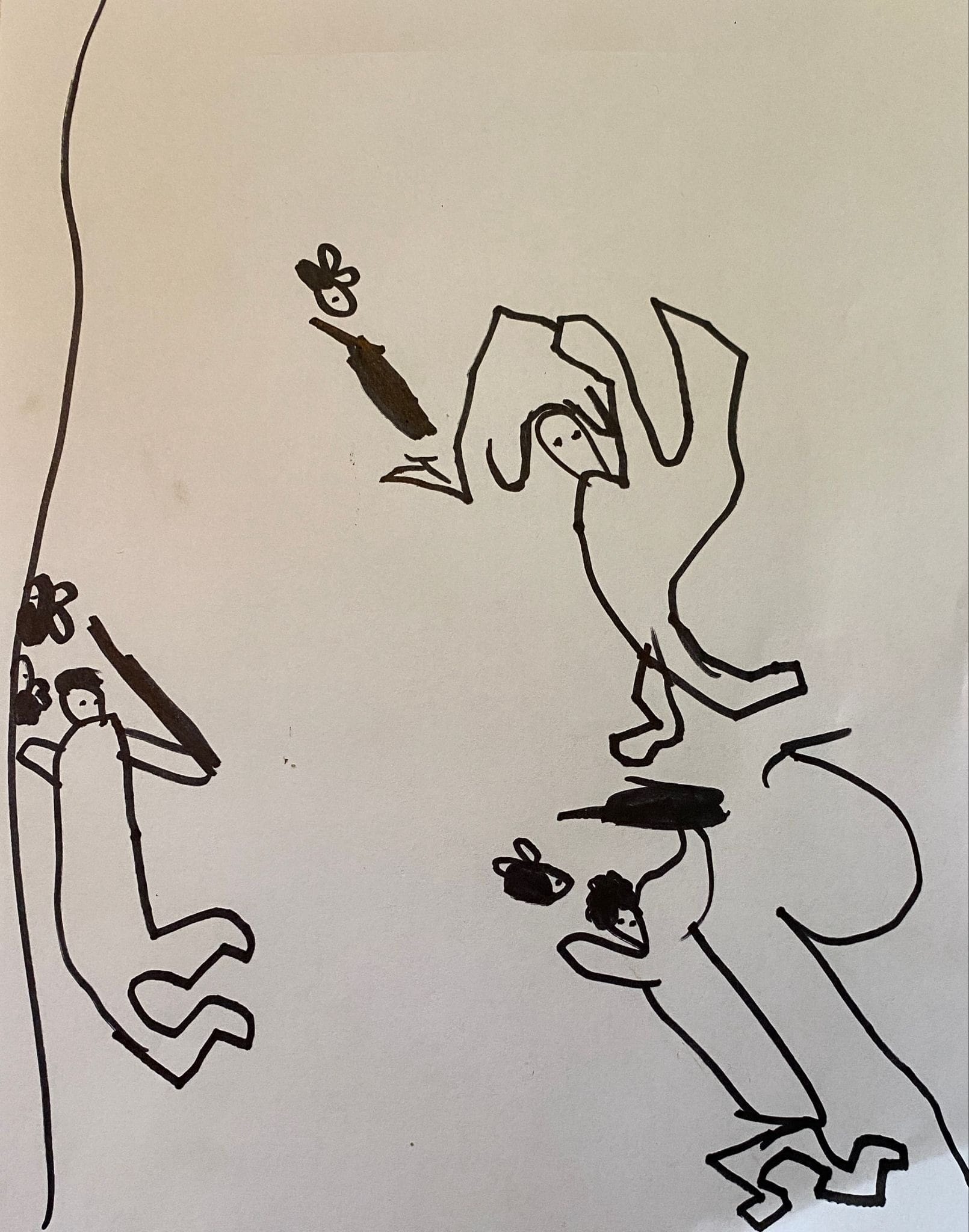
This past May, I was out on the playground one morning as the termites swarmed, attracting the attention of children arriving at school. During a 20 minute period, children:
- tried to kill the termites
- played with the termites
- were scared of the termites, and
- intervened by chasing the sparrows away and then debated whether to protect the termites from the sparrows or let the birds have their breakfast.
In each situation, I had to decide how to respond, knowing these responses were part of my effort to socialize the children toward solidarity with the natural world.
I took photos and notes and created a short documentation story of the episode which I shared in small groups with: Maggie Oliver and Vaidehi Desai (the Green Dragonfly teachers-the five-year olds); Jenna Rounds, Sam Liptak, and Franny Alani (the Purple Fish teachers–the three-year-olds) and Annawon Weeden (a Native American educator who works with the Purple Fish); Megina Baker (a coach for the Boston Public Schools Early Childhood Department), Caitlin Malloy (Newtowne School’s director), and Green Dragonflies Philip, Nathan, Elliot, Leo, and Carter and Blue Otters (4s) Orla and Jack. I asked the educators how they would have responded to each of the four situations brought up in the story, and the children what they thought the children in the story should do.
Spoiler alert. For all the situations the answer is: it depends. As Caitlin noted, “The answer to how to respond depends on what goals you are prioritizing at that moment.” Is fostering an empathetic relationship with the rest of nature the top concern? Is helping children consider and debate complex situations the priority? Beliefs about effective ways to socialize children and teaching styles also play a role.
This essay shares the documentation from the playground and my and my colleagues' perspectives about each of the four situations that arose during the episode. The examination of the four decision points provides opportunities to consider what to do in similar situations. It will be clear that teaching, including, “just hanging out with children on the playground,” is a complex cognitive task.
One morning in May
From 8:00 to 8:30 AM, children from all four classrooms at Newtowne can participate in “Early Drop", generally on the playground, before the start of the formal school day. One Monday morning in May, I was the Early Drop teacher. Nathan and Philip (Green Dragonflies) and CC (Orange Sea Star–three-years-old-and Philip’s sister) were among the first to arrive.
Philip immediately began hunting the termites, trying to grab those in the air and stomping on those crawling on the ground. Seeing this, I asked:
Ben: Why are you stomping the termites?
Philip: Because they are going into my nose.
Ben: Tell them not to.
Philip: OK.
The stomping stopped and I asked, “Did it work?” Philip responded affirmatively, and was carefully observing the critters. He began to try to get them to crawl on him.
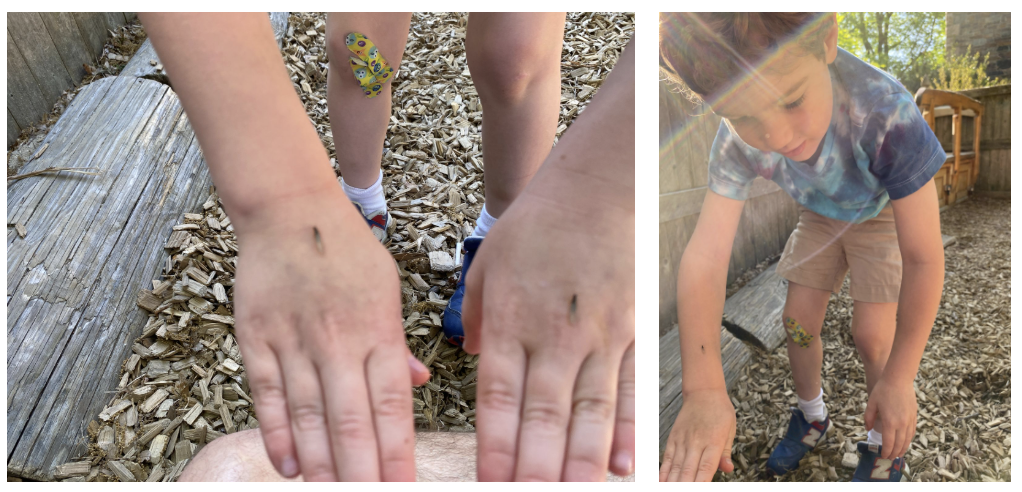
When he was successful Philip declared, “I’m the termite king!” and excitedly showed me the insects on his hands.
Nathan asked Philip to help get termites to crawl on him. Philip responded, “You have to get them yourself.” Nathan went off in a huff to the far end of the playground. (How to support Nathan during these moments of frustration is an important teacher decision point which is beyond the scope of this essay.) He soon returned, and was successful in getting termites to crawl on him. He proudly told me about his accomplishment.
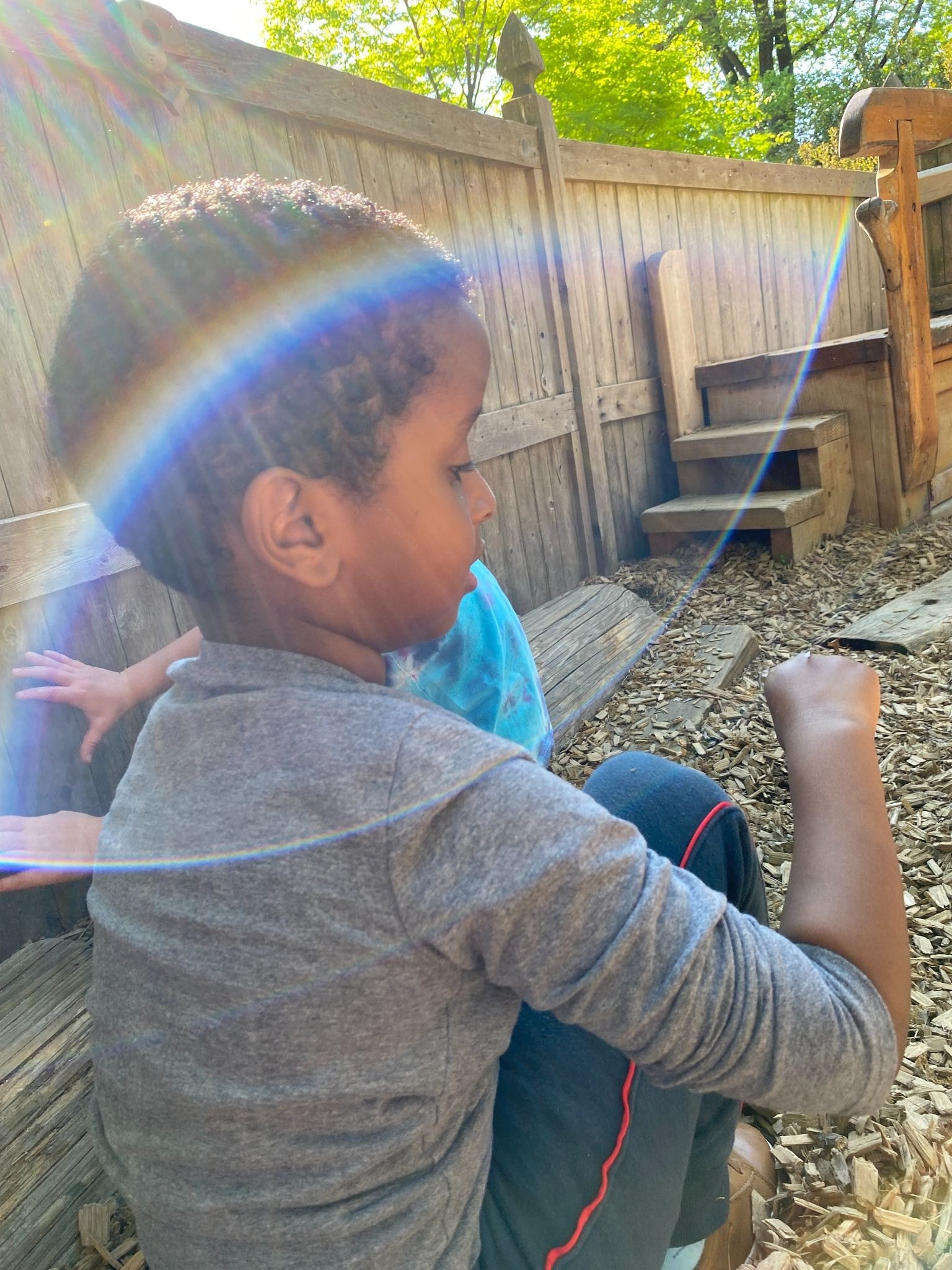
CC watched her brother and friend interact with the termites and noticed one crawling on my leg. She seemed curious about what was going on.
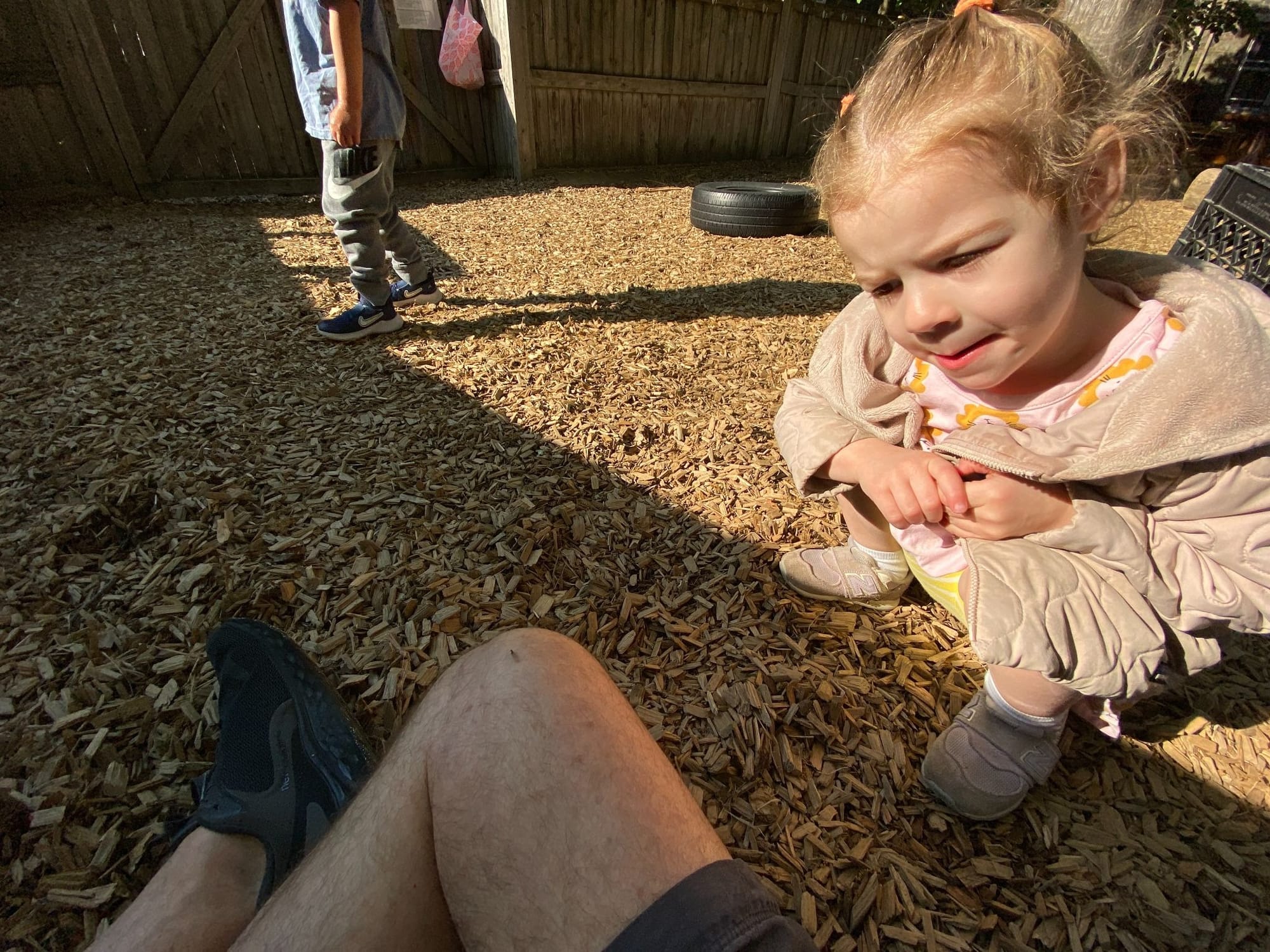
But then she said she was scared and started to cry. I was surprised; CC is generally not fazed by bugs. I told her she could sit on my lap and can let the termites know, “I’m big and you are little, so I’m not afraid of you.” She continued to cry.
Ben: I’m wondering what is worrying you about the termites.
CC: They are going to get on me.
Ben: If they get on you, you can shoo them away.
Philip: Do you want me to help you?
CC: I want to go inside…Get them away from me!
For the remainder of the outside time, CC expressed concern about the bugs and cried. After a few minutes I moved away from the area of the most termite activity (where Philip was playing). CC sat on my lap. Occasionally I reiterated that, “I’m taking care of you and keeping you safe. And there are bugs all around us. You will be happier if you get used to them.”
In the midst of CC’s unhappiness, Green Dragonfly Elliot arrived. His father reported that over the weekend Elliot and his family intervened on two separate occasions to help critters: a baby rabbit and baby turkey.
Philip showed Elliot the termites crawling on his hands. He was very interested.
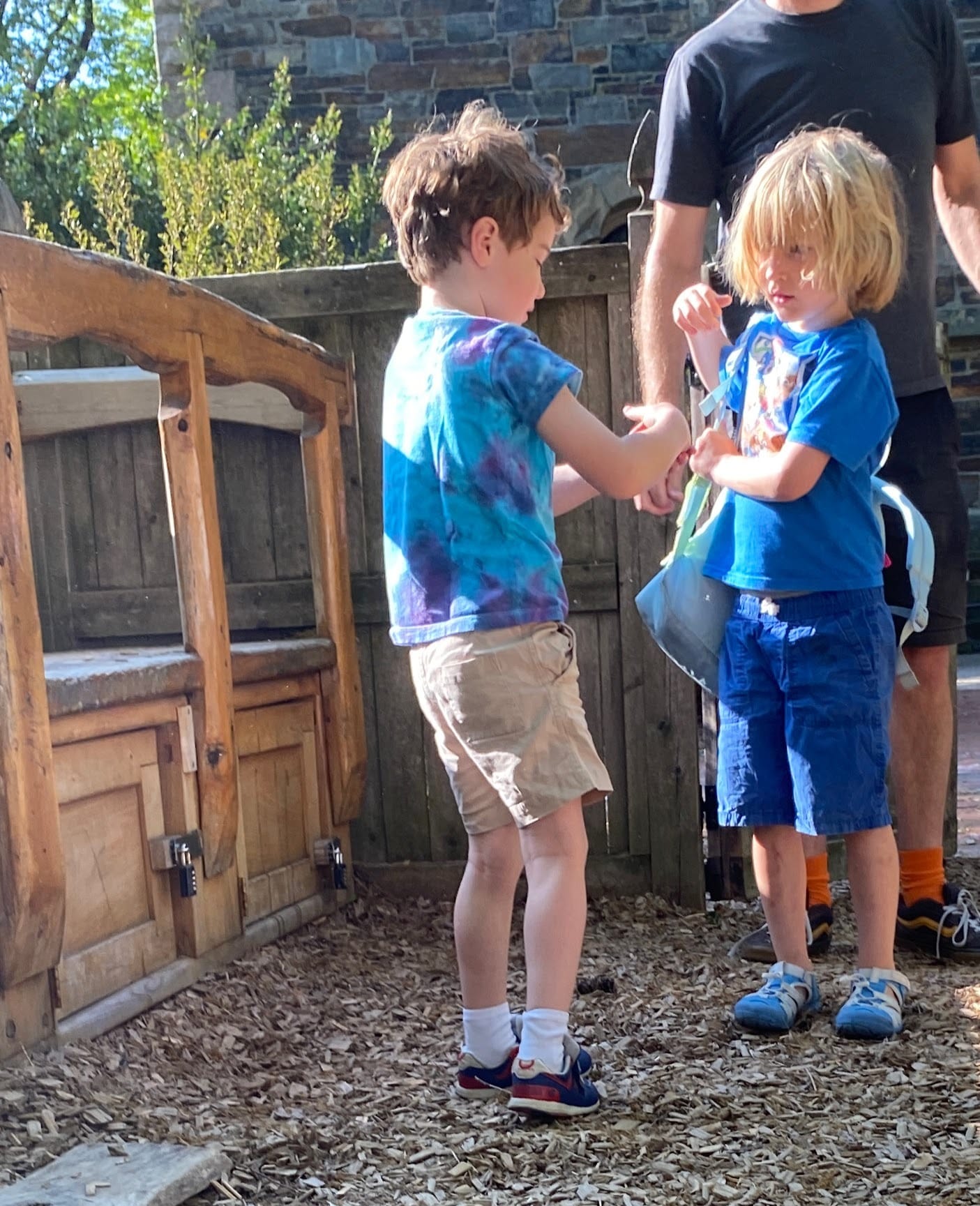
Elliot then noticed a group of sparrows on the ground, feasting on some termites in the middle of the playground. He chased them away, leading to this conversation:
Ben: Elliot, I’m wondering what you are up to.
Elliot: We need to protect the termites.
Nathan: It’s not nice to them [the sparrows]. They like termites to eat.
Ben: What should we do? Let the birds eat the termites or protect the termites?
Elliot: Protect the termites.
Nathan: No, that's not fair. Let them have their breakfast.
At 8:30 Green Dragonflies headed to their classroom. Inside Philip continued to talk about being king of the termites and was excited to find a termite crawling on his shirt. “Look, he followed me in” Philip told his friends.
When children stomp
Solidarity with nature is not just about caring for charismatic mammals. Insects, whose populations are declining worldwide, play vital roles in ecosystems.
My colleagues and I are aligned in that we do not want our kids randomly killing critters. Rather than using our authority to try to stomp out the impulse some kids have to crush bugs, we work to help children understand why such killing is wrong.
The Green Dragonfly and Purple Fish teachers try to get children to take the insects’ perspective, asking kids how it might feel to have something so much bigger than you trying to hurt you. They read the children books written from the bugs’ perspectives. Maggie and Vaidehi explain that on the playground, “We are in their house right now so we should respect their space. If you don’t like them just back away. They have the right to play in their own house.” Sam shares the importance of bugs. For example, she will explain bees' role as pollinators and how they make the world more beautiful by helping flowers and trees. She also talks about how interesting it is to watch spiders spin their webs and termites fly through the air.
Caitlin thought that my asking Philip a question initially (“what is worrying you about the termites?”) was useful. However, she would have taken a “more practical/less silly” approach, challenging Philip’s assertion that the bugs were going up his nose (unlikely) and telling him directly, “This is another living creature you are hurting,”
That is certainly a reasonable response. However, I enjoy leaning into children’s whimsy. I found Philip’s contention that the termites were trying to go up his nose humorous and playful, and responded in kind (“tell them to stop”). In this case, meeting him in his “reality” was effective.
More generally, it seems that our collective efforts have been effective. While, as seen at the start of the early drop period, children at Newtowne will occasionally stomp on bugs, they have embraced an ethos of respecting them. A few days after the morning on the playground I asked Elliot and Philip, “Is it OK to stomp on ants or termites?” Both responded no, Elliot telling me “That’s breaking nature.” Philip added, “It is hurting them. And also they lose their families.” Internalizing this message, I believe that the children will be inclined to be respectful of bugs even when adults are not around to tell them to stop stomping.
When children play
Play is a central way children build relationships and make friends. Ask a five-year-old why a certain person is their friend and the response will often be, "Because I play with them.” Might play be a way children make connections to other creatures and build solidarity with the natural world?
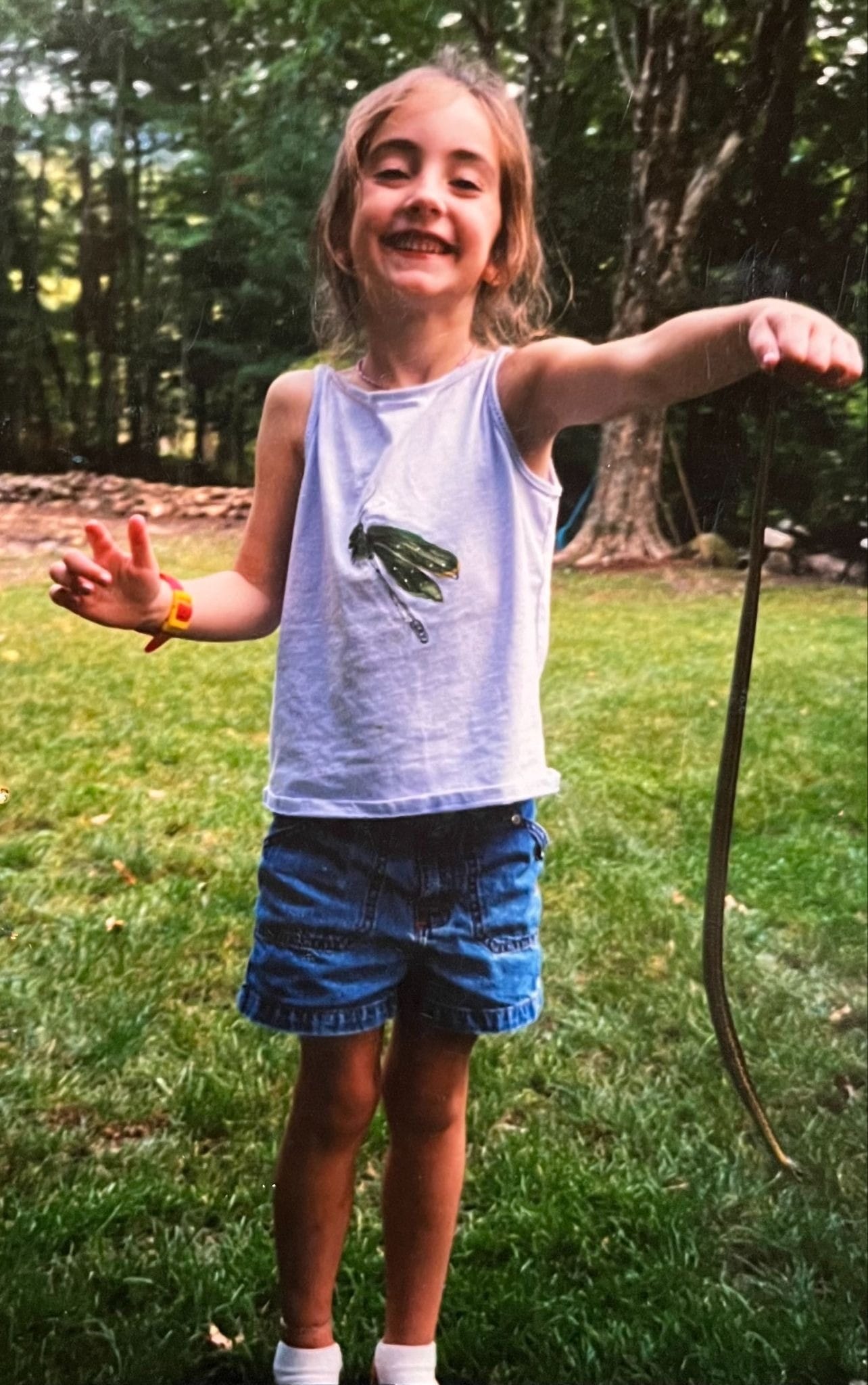
The Newtowne faculty were supportive of Philip engaging with the termites and letting them crawl on him. Annawon was impressed by his pivot from stomping to playing. Maggie recalled her childhood in rural Vermont where she made connections with a host of critters, including snakes, by playing with them. She noted that her parents taught her to interact with critters that were safe for her and respectful of them.
Megina, however, raised a concern. While agreeing that playing is far better than killing, declaring oneself a “termite king”, which has implications of domination, is not the relationship she wants to encourage for children to the rest of nature. Mentioning this to my colleagues gave them pause; it was something we wanted to think about more.
When I raised Megina’s concern with Caitlin she noted the complexity of the situation. Knowing that a central focus of my work in the studio over the past three years had been the cultivation of solidarity with nature, and imagining that Megina may well have been responding with the current political climate in the United States in mind, Caitlin argued that how the teacher should proceed here depends:
If the goal is to engage with termites and become “friends”, then letting Philip play on makes sense. But if the goal is to bring up children with the ethos that we live in a country with no kings, then we would want to move the conversation in a different direction.
While in the playground photographs Philip seemed interested and curious, even tender towards the termites, we all wondered what being the termite king meant to him.
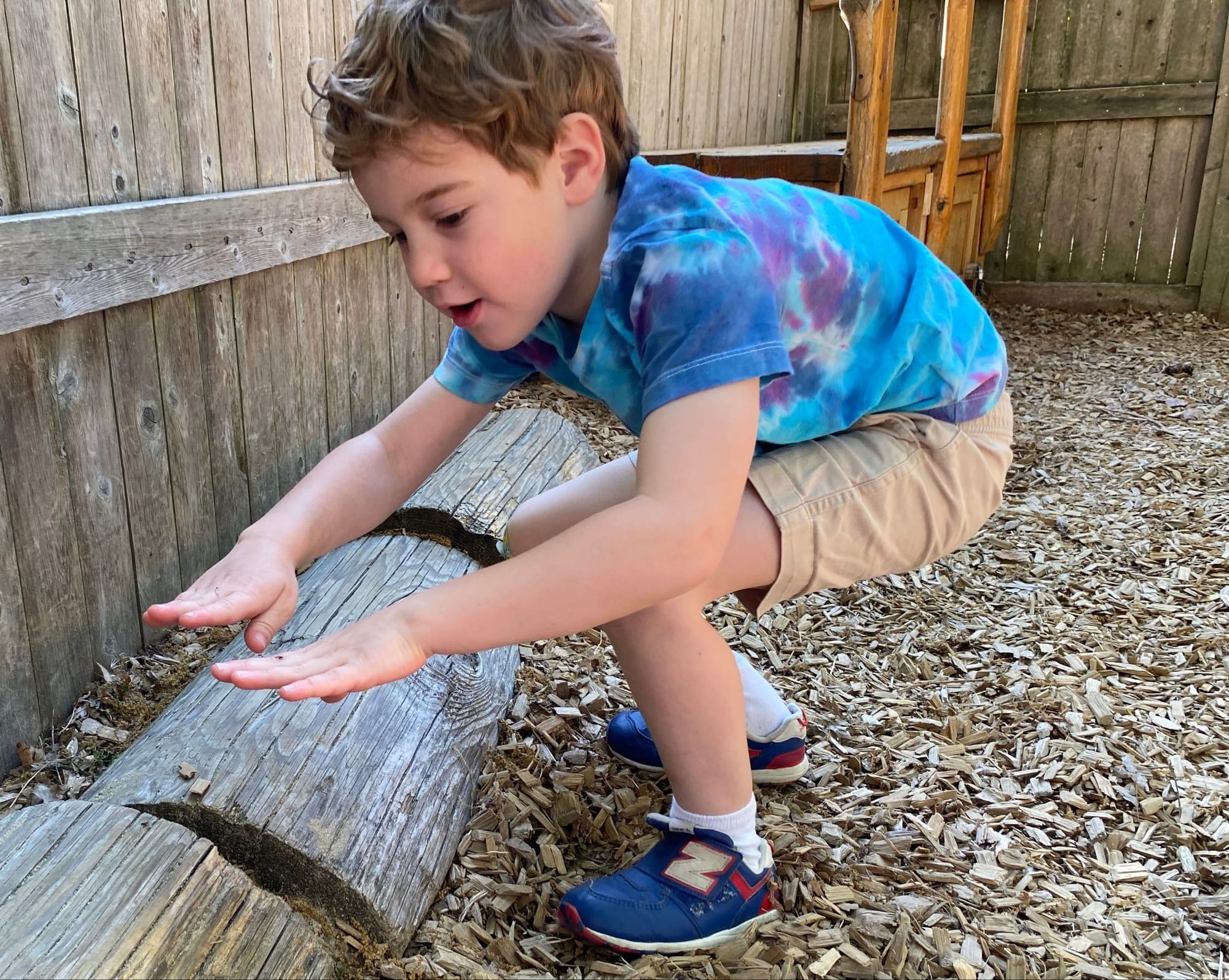
So a few days later, when he and Elliot were having lunch in the studio, I asked him. While the conversation quickly took a turn I did not expect, I did gain information about Philip’s understanding of the play:
Ben: What does it mean to be the termite king?
Elliot: But he is not the termite king in real life.
Philip: I am in real life.
Ben: But what does that mean?
Philip: The leader of termites.
Ben: What does the leader do?
Philip: I make them go on me.
Elliot: The termite king is actually a termite. The biggest termite.
Philip: It doesn't have to be the biggest.
Elliot: Rose (Elliot’s sister) is bigger than you. She knows more than you.
Philip: My brother is bigger than Rose. And he knows more than Rose because Benny is eight and Rose is seven.
Trying to get the conversation back to my question I asked:
Ben: When Nathan had the termite go on him, was he the termite king too?
Philip: Yeah.
Where do I land on the question of Termite King? First, Maggie's comment that her parents taught her ways to play with critters that were safe for her and respectful to them resonates, and reminds me of a story Franny told about Purple Fish Clara. Clara was collecting ants in a cup and was frustrated because the ants kept crawling away. Franny's explanation, that it was likely the ants didn’t want to be in such a small space, made sense to Clara.
Of note, the termites, which could have easily flown away, stayed on Philip. He kept his arms steady, providing a secure perch for the insects. In this case how Philip was playing–with curiosity and care–seems more important than the title he gave himself. Regardless of whether a person could be a Termite King or not, Philip was certainly a benevolent monarch. Of course, others might have responded differently.
When children cry
Likely you know a child, or an adult, who is fearful of bugs. It might be that they do not like the look of these critters or the feel on their skin. This might be a learned or socialized behavior. For CC, there is the question of how to support her when she was crying about the termites and how to help her in the long run manage her fear of bugs.
In the moment, Vaidehi would have responded in a similar way that I did, acknowledging CC’s apprehension, giving her some language to feel safe (“tell the bug I’m big”), and being clear we are not going to stop coming outside. Jenna might have modeled curiosity about the termites from a safe distance. Megina would have probed further about why the bugs were scaring CC. Maybe she was worried she needed to follow her big brother’s lead and have them crawl on her. Maggie was pragmatic, explaining:
If I had to spend the rest of the morning outside with her I am redirecting her. We are getting a ball out and we are doing something different. Later, when we are back inside and she is removed from the situation, I would revisit the conversation. Perhaps we would make a card for the termite or look at pictures of termites.
Caitlin was also thinking about the long term. Having grown up in rural Maine, she had critters all around her, and like Maggie, sees the importance of children being comfortable interacting with insects. She also recognizes that kids growing up in Cambridge may not have these experiences to develop a comfort level with bugs. Invoking Vygotsky’s idea of Zone of Proximal Development, she wonders what experiences can scaffold children into a place that helps them feel relaxed and comfortable around the rest of nature.
Knowing CC, her reaction was perplexing to the Newtowne staff. Perhaps this was a morning she was particularly missing her parents. Indeed, later in the day when she was back on the playground with the other Orange Sea Stars, Jenna observed her telling a group of children who were poking the termites with shovels, “Don’t hurt the ants!”
When children intervene
I am alert to situations that do not have one right answer, or even any right answer, which children can discuss and debate. What to do about the termites and the sparrows is a perfect example, and led to some interesting discussions among the children. Jenna agrees that facilitating such conversations should be a priority in a country where reasonable debate can seem rare and is badly needed.
So discuss we did. I shared the story of the termites and sparrows with a group of Green Dragonflies and Blue Otters, and then asked, “Should Eliot have chased the birds away or let the sparrows have their breakfast?” Orla, a self-identified orthologist (and ballet dancer) was the the first to answer:
Orla: Birds need to eat bugs, so let the sparrows have their breakfast because birds think that bugs are really yummy.
Leo: Let the birds have their breakfast because I like birds a little bit more than I like insects.
Jack: I think insects are kind of yucky except for worms, so let the birds have their breakfast.
Carter: Protect the insects because once I was at a camp and I killed an insect and that was wrong.
Megina agreed that this was an interesting question to come back to, and then noted:
Who are we to say? It's not about us. They have their own relationship. Would kids always pick a side? You’ve given them a dichotomy. What if the prompt is: do we need to do anything here?
Fair point. By eating termites sparrows get nutrition and ensure there are not too many termites. Rather than making this into a debate about which species to favor, this could have been an opportunity to point out the balance of nature.
With this in mind, Caitlin noted that it depends. She explained:
How many times in our teaching do we take things that aren’t our business and use them for fodder for other goals? It all depends on your goal. Do you want to make this an opportunity for kids to negotiate or talk about how this is none of our business? That’s teaching. You have to pick, and it is hard to pick.
The difficulty, then, is determining which questions prioritize. In a world where human action is reshaping ecosystems at every scale, questions about interspecies relationships, intervention, and responsibility are very much our business. The challenge is that these issues are complex, and any single pedagogical moment can only hold so much complexity. Consider this example: The U.S. Fish and Wildlife Service, in an effort to save the Northern Spotted Owl, is exterminating Barred Owls who, because of humanity’s transformation of the landscape, have moved west and are now outcompeting the Spotted Owl in its habitat. Should we be slaughtering thousands of one species to save another? As citizens who may be involved in making such choices in the future, might we want to have children to start considering such trade offs?
It depends, and I like Philip’s proposal on how we should deal with the sparrows and termites. While perhaps not factually accurate, his idea has the nuance needed in such situations:
If they [the sparrows] eat all of the termites, the termites could go extinct. Maybe we let them eat a little and then we chase them away.
It depends
I recognize that answering a question “it depends” can carry an air of evasiveness. My intent here is to convey an understanding that there is more than one way to respond when children stomp on, play with, cry about, and intervene with critters. That there is no one way certainly makes teaching more challenging. It also makes teaching more interesting. I also hope it is clear that “it depends” does not mean that anything goes. In this case, it carries a commitment to being flexible and to core values such as solidarity with the natural world.
This essay has described conversations grounded in documentation that help navigate the uncertainty that “it depends” creates. The documentation allowed us at Newtowne to gain Megina’s outside perspective which made our conversations richer.
In future moments on the playground will certainly face decisions about how to respond when children stomp on, play with, cry about, and intervene with critters. Having engaged in these conversations will make my responses more thoughtful and aligned to the values I want to promote.
Thanks to my colleagues and friends–Maggie, Vaidihi, Jenna, Sam, Franny, Annawon, Megina and Caitlin–for playing with these ideas with me.
Thanks to Liz Merrill and Caitlin Malloy for their always helpful comments on drafts of this essay.