
The Betrayal of Isaac

Ben Mardell and Amos Blanton
Politically, 2026 has started as a continuation of 2025, only darker. Amidst the chaos, we worry that attention to the climate crisis is being lost. So we begin the year with a reminder about the science of climate change. This science, along with the reality that powerful political and economic interests are undermining meaningful climate action, is depressing news. News which begs the question, what should we do? While we do not have an "action plan" we will follow two essays, one that offers some ideas for fellow educators and the other pondering how one should live one's life in this time of rapid climate change.
Breaking the bargain
Genesis 22 begins with God commanding Abraham to:
Take your son, your only son, whom you love—Isaac—and go to the region of Moriah. Sacrifice him there as a burnt offering on a mountain I will show you.
Abraham obeys. He journeys three days to Moriah, builds an altar, binds his son, and is about to sacrifice him when an angel intervenes, telling him to sacrifice a ram instead.
For many the moral of the story is the rewards of obedience. For his willingness to follow God’s command to kill his son God promises Abraham that his offsprings will be numerous as, “sand on the seashore” and prosperous as well.
But the story hinges not only on Abraham’s obedience. Issac comes with his father and allows himself to be bound to the altar. Recounting Issac’s acquiescence, the writer Pat Barker notes that it encapsulates the bargain that many societies are based on. She explains:
If you, who are young and strong, will obey me, who am old and weak, even to the extent of being prepared to sacrifice your life, then in the course of time you will peacefully inherit and be able to exact the same obedience from your sons.
We, the older generation, are breaking this bargain. Because of human caused climate change, the world young people will inherit from us will be fundamentally degraded from the one our elders left us. A world with fewer fellow species. A world with more dangerous, extreme weather. A world with rising seas that will flood cities and swallow valuable agricultural land.
This is dramatic rhetoric, and rhetoric that is completely accurate. Even when we speak in more measured terms about our work as educators wrestling with teaching in the time of climate change we have been asked: “Why are you so pessimistic? and “Will it really be so bad?” Occasionally our interlocutor will ask to change the topic to “something more pleasant.” If we are in conversation with someone informed about climate change, a second question emerges, “What should educators be doing to prepare children for the uncertain future they face?” To answer the first question, in this essay, we share a summary of the science about human driven climate change.
What the science tells us
The science is clear: human activity is damaging our planet. Greenhouse gases are causing an unprecedented warming of the earth. The damage has begun and unless drastic action is taken the results may be catastrophic for humanity. At the very least, climate models point to a very uncertain future for the children we care for.
Before we explain what the science is telling us, this is what we mean when we refer to “the science.” We are talking about decades of research–data that have been collected and analyzed and predictive models constructed and revised–by meteorologists, oceanographers, geologists, ecologists, physicists, chemistry, engineers, computer programers, economists, anthropologists, and citizen scientists from around the globe. While climate models cannot predict with complete accuracy what the future holds (the earth is an extraordinarily complex and dynamic system), based on the aggregate of research efforts the science gives us the best estimates of, for example, sea level rise given specific levels of greenhouse gas emissions.
The most authoritative synthesis of this research are the reports issued by the United Nation’s Intergovernmental Panel on Climate Change (IPCC). Organized around a rigorous review process, the IPCC brings together thousands of experts from every continent to assess the state of climate change approximately every five years. The most recent report was released in 2023. While some climate scientists have criticized the reports for understating the risks posed by climate change, the IPCC’s findings are the global consensus on what the science says. The 2023 IPCC report explains:
Human activities, principally through emissions of greenhouse gases, have unequivocally caused global warming…Human-caused climate change is already affecting many weather and climate extremes in every region across the globe. This has led to widespread adverse impacts and related losses and damages to nature and people (high confidence). Vulnerable communities who have historically contributed the least to current climate change are disproportionately affected…Continued greenhouse gas emissions will lead to increasing global warming…Every increment of global warming will intensify multiple and concurrent hazards...Climatic and non-climatic risks will increasingly interact, creating compound and cascading risks that are more complex and difficult to manage.
The report includes a dire warning which the science supports with a very high level of confidence:
Climate change is a threat to human well-being and planetary health. There is a rapidly closing window of opportunity to secure a liveable and sustainable future for all.
Over the past two centuries human activity–car emissions, coal burning power plants, agricultural practices, natural gas extraction, and more–have significantly altered the earth’s atmosphere through the release of greenhouse gases: carbon dioxide, methane, and nitrous oxide. The amount of carbon dioxide in the atmosphere is 50% higher than it was two hundred years ago. Humans continue to pump greenhouse gases into the atmosphere, with no end in sight. It is important to note that carbon dioxide stays in the atmosphere for a very long time. Half the carbon emitted today will still be in the atmosphere, causing warming, when our students are middle aged.
The greenhouse effect describes how the earth’s atmosphere allows energy from the sun through, much of which is absorbed by land and water, and captures some as it is radiated back towards space, warming the planet. Acting like a greenhouse or the inside of a car with its windows up on a sunny day, a natural level of greenhouse effect is essential to life on earth. While the analogy is not perfect (the earth’s atmosphere is more complicated), it does capture the basic problem: the human-enhanced greenhouse effect increases the heat retained by the atmosphere, resulting in too much energy in the planetary system.
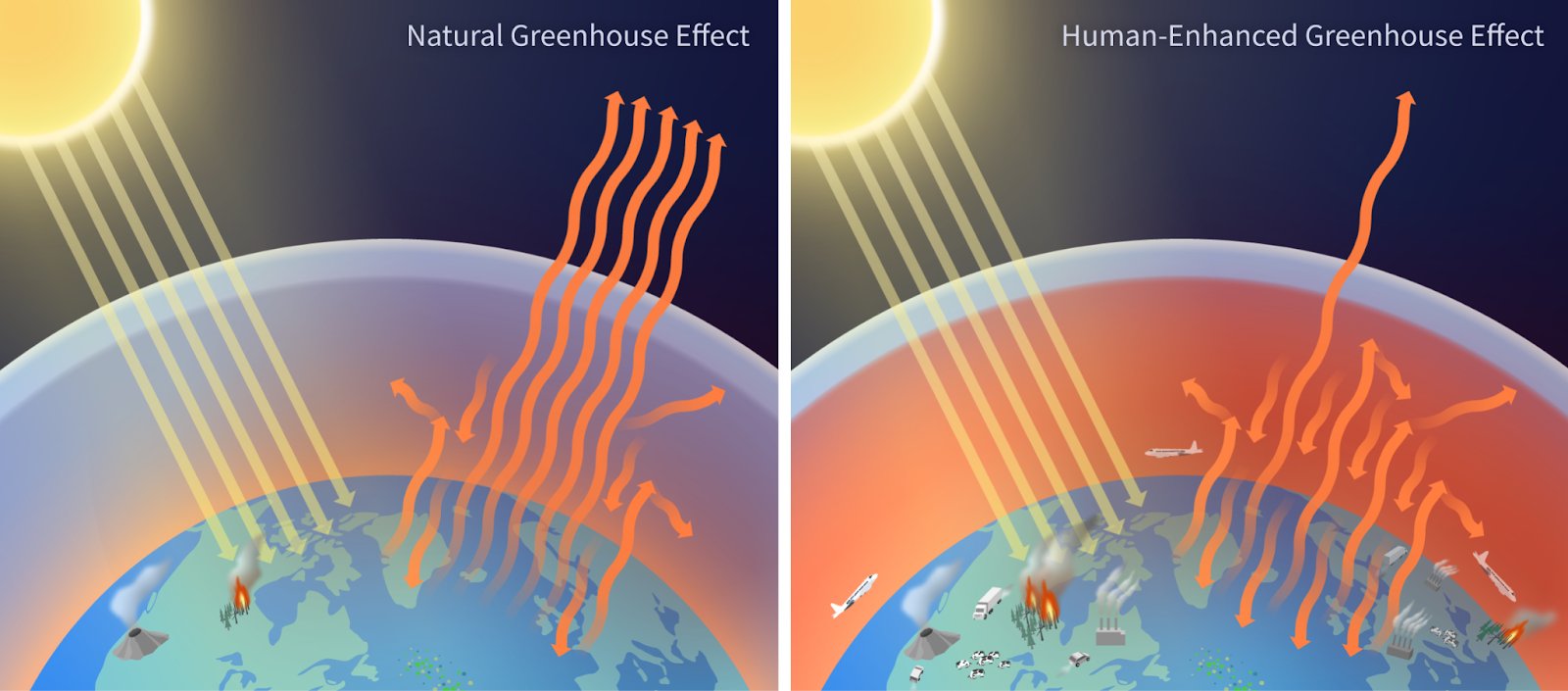
As predicted by this theory, the world is warming. According to an annual report from NOAA, 2024 was the warmest year since global records began in 1850, breaking the previous record set in 2023. The ten warmest years in recorded history have all occurred during the last decade. Twenty years ago 2005 was the warmest year in history. Now, 2005 is the 13th-warmest year on record.
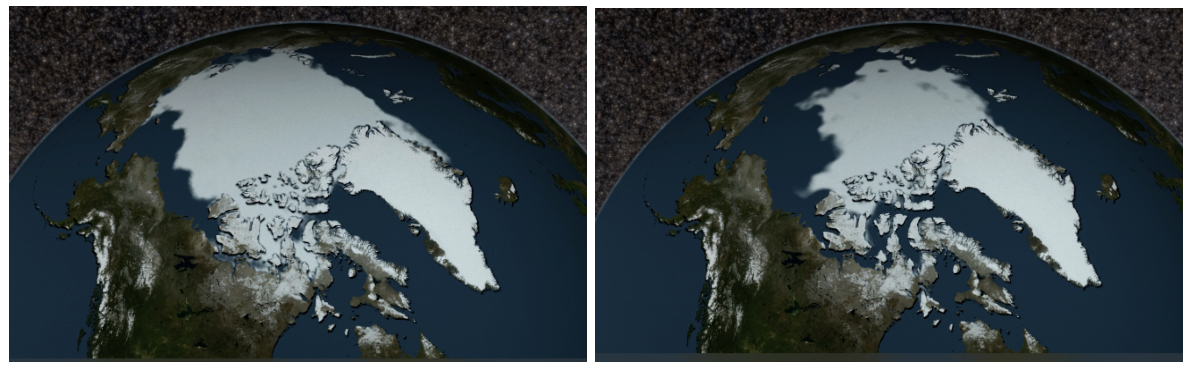
There are many implications of rising temperatures. Less ice cover at the poles and held in glaciers is one of the most visually striking and important. Since measurements started in 1979, the minimum Arctic ice cover has decreased by a third.
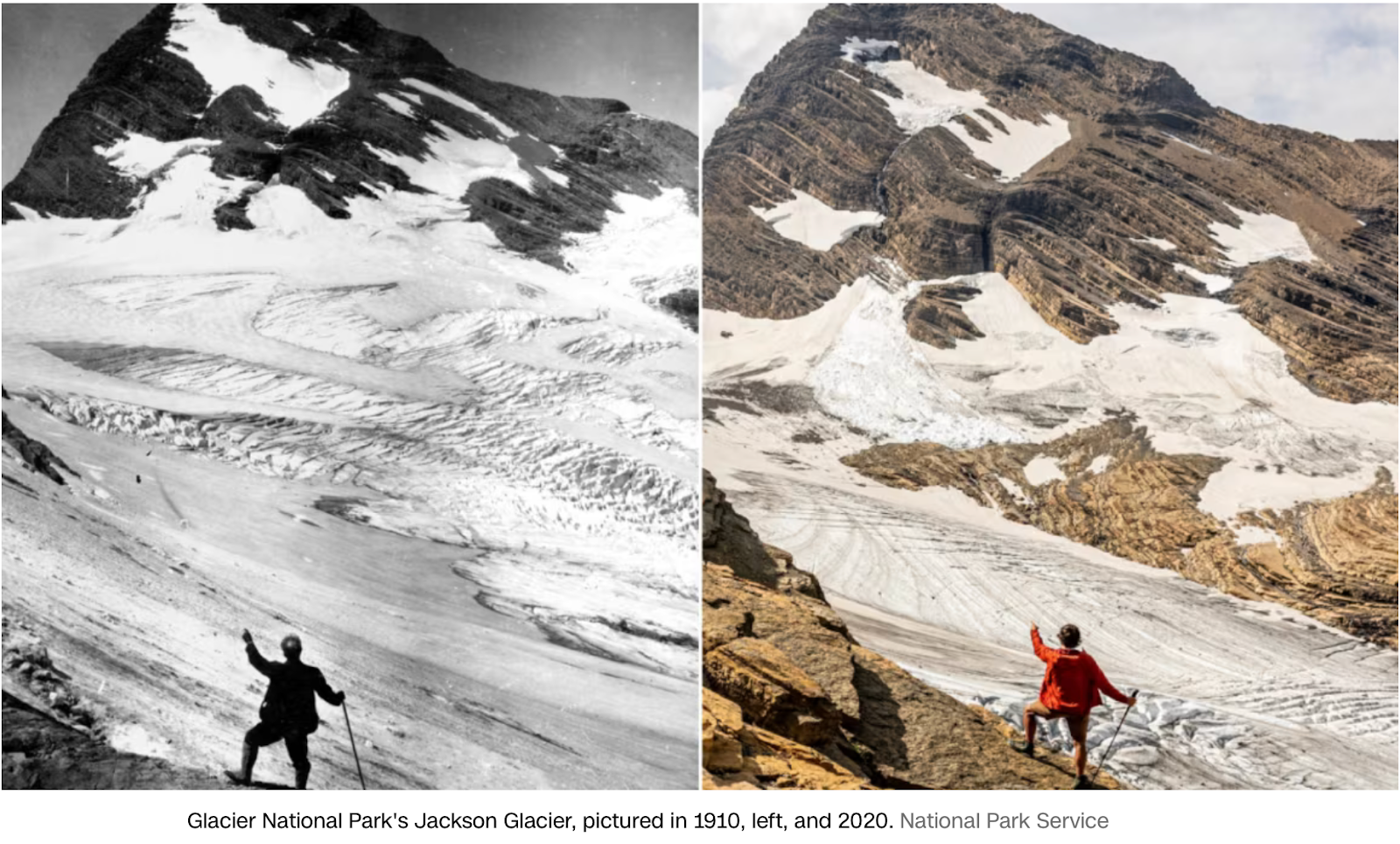
In 1850 there were 80 glacier-like areas in what is now Glacier National Park in Montana (USA). That number had decreased to 26 by 2015. It is likely that, within the lifetimes of the children we teach, there will be no glaciers left in the park.
As terrestrial glaciers melt, large volumes of water flow into the ocean. Melting glaciers on Greenland and Antarctica have caused the most sea level rise. Melting Arctic sea ice does not cause much sea level rise directly, but as the ice disappears, sunlight that had previously reflected off the ice instead warms ocean water. Warmer water takes up more volume than colder water, and this 'thermal expansion' is a major contributor to rising sea levels.
Sea levels have risen about 8 inches / 20 cm in the past century. This is a trend that is accelerating (half the 8 inch rise occurred in the past 25 years), and almost certainly will continue. The exact amount of future change depends on how quickly we move to reduce emissions of greenhouse gases.
NOAA’s Sea Level Rise Viewer provides vivid illustrations of the impact of rising oceans on the coastal areas of the U.S. Looking ahead sixty years, well within the expected life times of the children at Newtowne School, the predictions are apocalyptic. In Cambridge, Massachusetts, where Newtowne is located, the NOAA model shows a sea level rise of over 5 feet by 2080. The results will be that the Charles River will spill over its current banks and permanently flood low lying areas of the city.
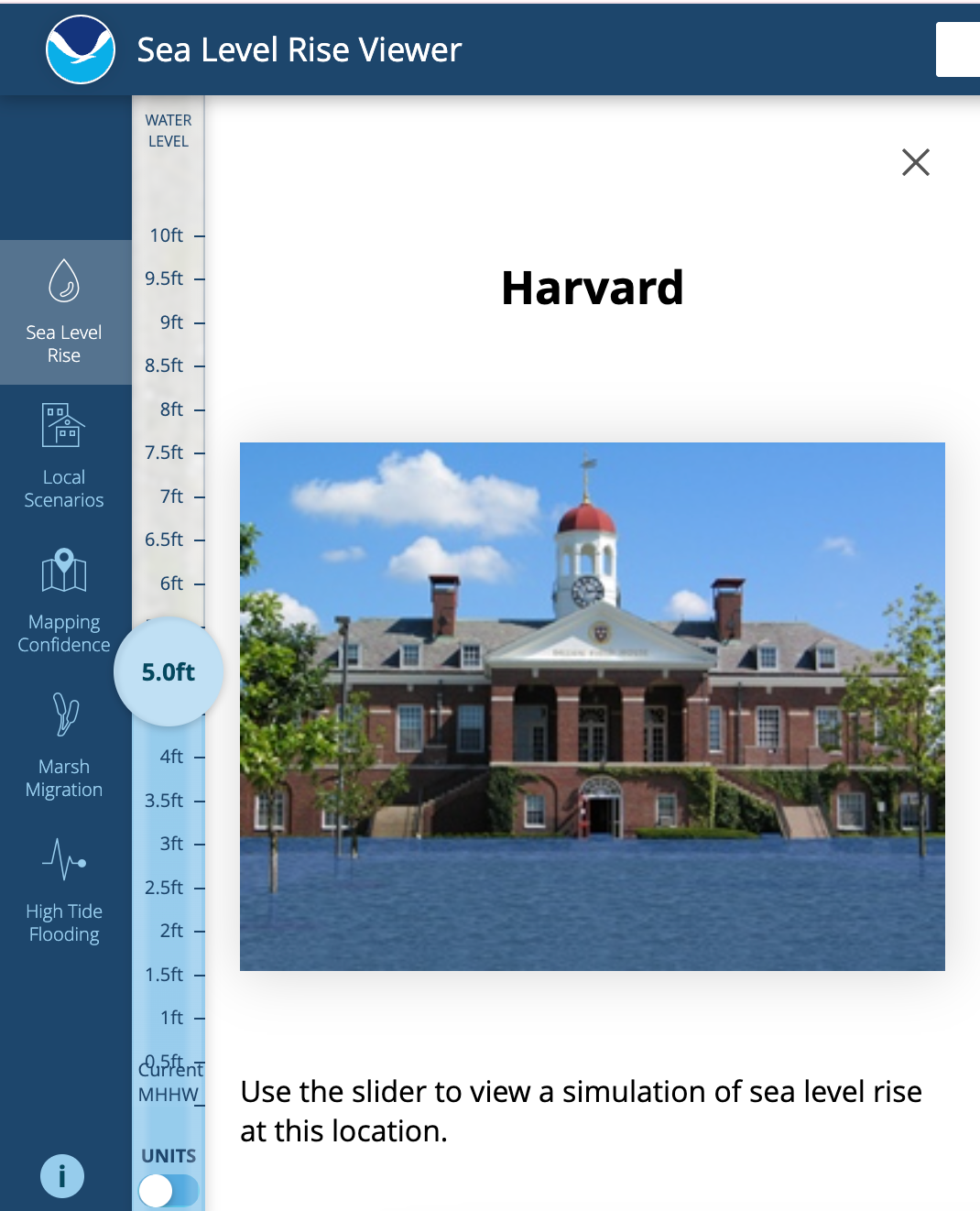
The above photo is a simulation of the lawn in front of the building at the Harvard Business School. Of course, in this scenario, the building in the photo would no longer exist.
Rising sea levels impact not just buildings and people. Coastal marshlands, essential to the survival of countless species, will be destroyed. It is estimated that the continental U.S. has already lost 50% of its coastal marshlands. Rising sea levels will add to this loss.
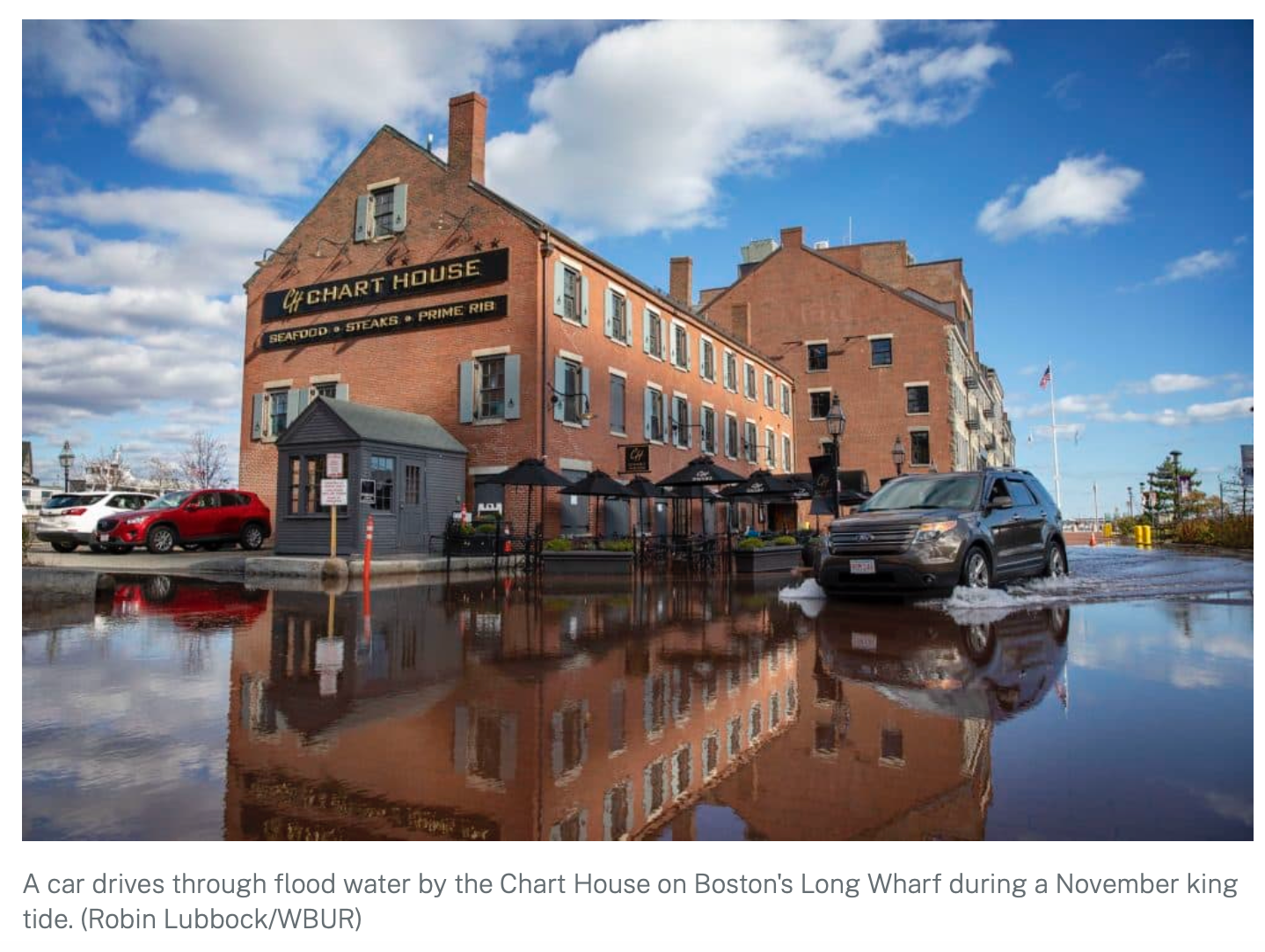
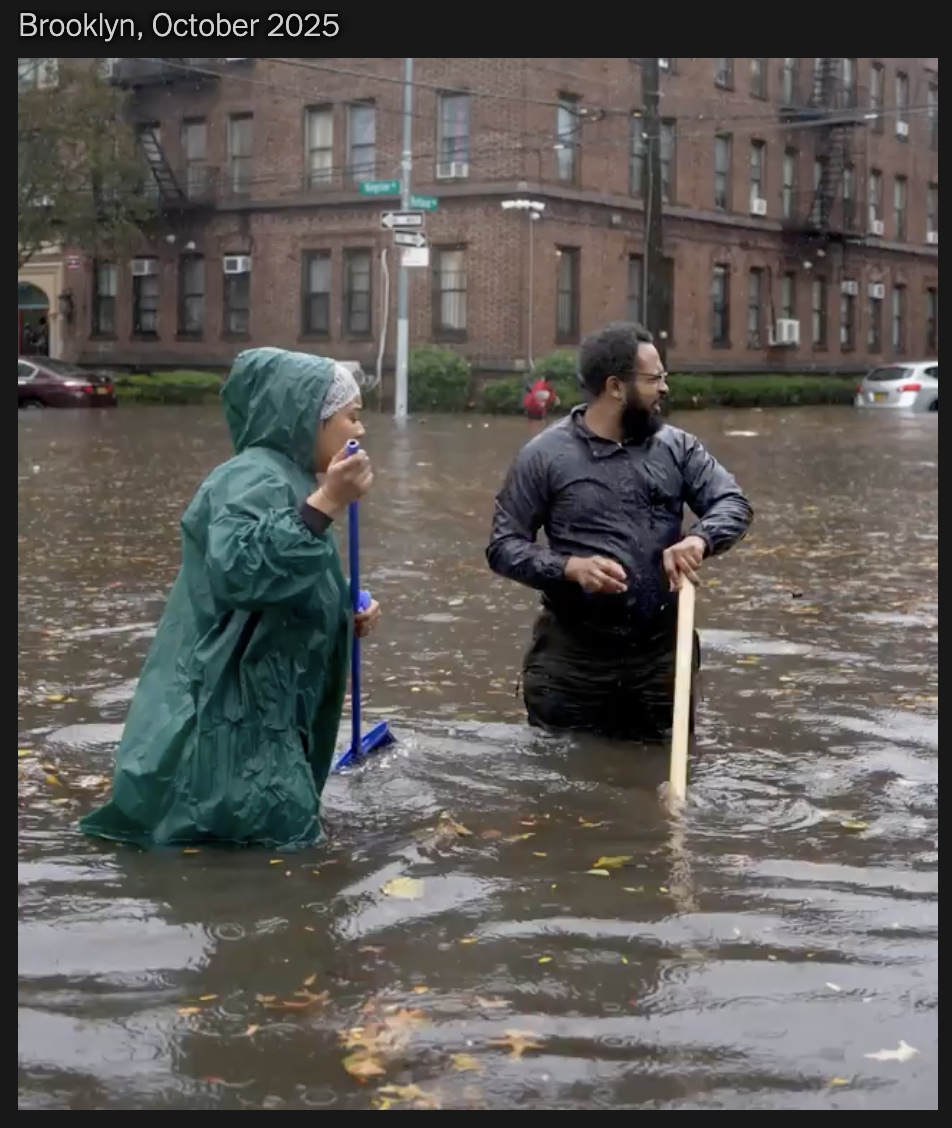
The problems caused by sea level rise are not just future ones. Communities in Fiji, Bangladesh, Panama, and the U.S. (Louisiana and Alaska) have been displaced. Coastal communities around the world are seeing the results of sea level rises in the form of “sunny day flooding” where higher sea levels mean higher tides. The resulting flooding damages buildings and infrastructure, snarls traffic, and disrupts public transportation. Scenes like the following in Boston and New York City are becoming more and more common.
Then there is the danger of storm surges. In 2012, the storm surge that accompanied Superstorm Sandy inundated neighborhoods in New York and New Jersey. Even then, the impact of the storm was exacerbated by climate change. It is estimated that the higher sea levels that were the result of global warming caused over $8 billion of additional economic damage. As sea levels rise, and more powerful storms arrive (the result of warming oceans), such “once in a century” occurrences like Sandy are becoming more frequent. If a storm similar strength to Sandy made landfall in New York today, it is estimated the storm would be 2 feet higher, potentially putting 25% of the city under water.
Stories similar to the one about ice melt and sea level change could be told about other impacts of warming. Because of climate change, there will be more extreme weather, droughts, and fires. Land will be made uninhabitable. Food production will be disrupted. Climate change will continue to stress economic, political, and social systems. It is frightening to imagine the implications. The children we care for face a very uncertain future.
And so…
We imagine that reading the previous section was difficult. It was hard to research and to write. The implications of climate change are scary and can feel overwhelming. But the realities cannot be ignored. We can't just talk about something more pleasant. To do so would be a betrayal of our children.
And they are being betrayed by political and business leaders. These leaders have, for decades, known the science described above. Each year rising temperatures confirm the climate models, yet they continue to promote fossil fuels for power and profit. 2025 saw set back after set back in efforts to mitigate climate change. The U.S. in particular abandoned climate change agreements, set up roadblocks to sustainable energy, and pressured other countries to emit more carbon into the atmosphere. The fact that most of those who hold power today are undermining efforts to mitigate climate change and create a more just and sustainable future is perhaps the most depressing news of all.
We struggle with the implications of climate change and the realities that greed is blocking climate action. As educators we have been pondering that second question: what should we be doing to help prepare our learners for their uncertain future? We address this question in Play Like a Platypus, our next post.
We are also asking ourselves what this means more generally, for our civic lives, our eating habits, and the way we do our work? We (Ben and Amos) live in the United States and Western Europe, and so are among the populations who contribute the most to greenhouse gas emissions. We are also currently insulated from the most serious effects of global warming, but not from our moral responsibilities. Amos addresses the question of what this means for how we live our lives in an upcoming post titled Playing is sub-optimal, which is why it can change the world.
Acknowledgements
The Pat Barker quote comes from her novel Regeneration, part of a trilogy set during World War One and well worth a read.
Thanks to Sam Mardell for his input on the science of climate change. Robbie Berg, Mara Krechevesky, Amy Rothschild, Caitlin Malloy, and Liz Merrill provided generous feedback on previous drafts.
References
The analysis about the impact of carbon and other greenhouse gases emissions is based, in large part, on information accessed in December, 2025 from U.S. government websites. The Trump administration has eliminated funding for many of the agencies conducting climate related research and banned some from mentioning climate change on their sites. It is unclear if this information will still be available when you read this post.
https://www.nps.gov/glac/learn/nature/glaciersoverview.htm
https://www.jpl.nasa.gov/news/nasa-analysis-shows-irreversible-sea-level-rise-for-pacific-islands/
https://tidesandcurrents.noaa.gov/high-tide-flooding/annual-outlook.html
https://science.nasa.gov/earth/explore/earth-indicators/arctic-sea-ice-minimum-extent/
And two other sources we relied on for our description of climate change:
https://en.wikipedia.org/wiki/List_of_areas_depopulated_due_to_climate_change
https://www.nytimes.com/interactive/2025/11/25/nyregion/nyc-storm-hurricane-flooding.html#