
Creativity is not enough: Further reflections on the Leaf People
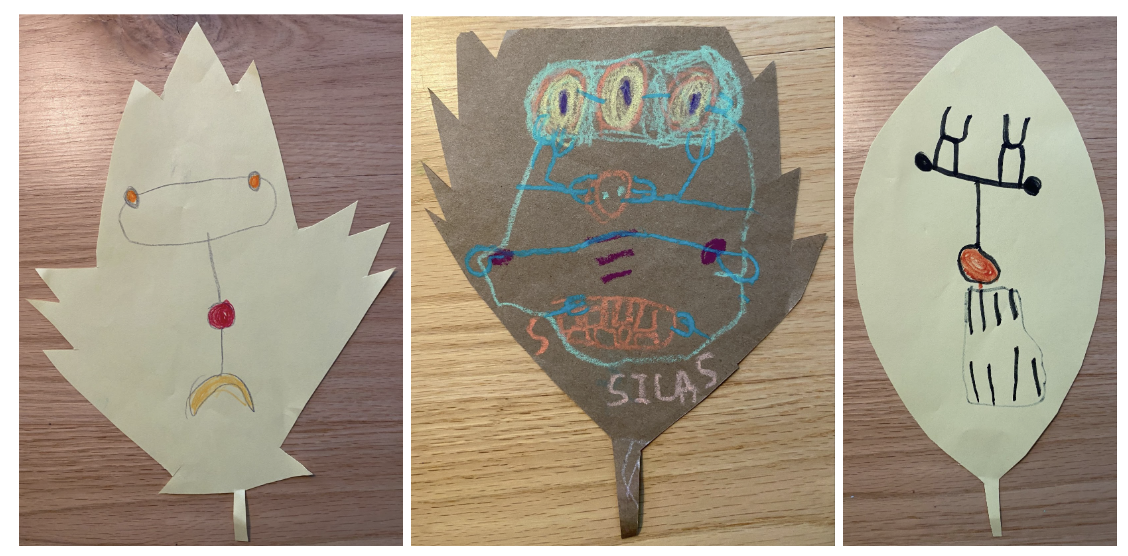
This essay builds on a previous post about collective imagination and The Leaf People. I argue that as part of creative, collaborative activities teachers need to point children in the direction of care.
The Leaf People
In The Leaf People: An exercise in collective imagination, I described a school-wide project at Newtowne School where the children collaboratively created the imaginary world of the Leaf People. They were told the Leaf People were kind, inclusive (I explained anyone who wanted to could be a Leaf Person), and had adventures. Beyond that, the children were free to decide who the Leaf People were and what they did.
Through play, drawing, and storytelling the children at Newtowne collectively imagined the lives of the Leaf People: what they ate, where they lived, who their friends were, and how they made friends. Here the children acted like the science fiction writers who build worlds, and, in fact, writing and illustrating books were a central part of the inquiry. The four-year-old Blue Otters wrote a collection of narratives titled Leaf People Stories. The five-year-old Green Dragonflies authored a series of books: The Leaf People, The Leaf People’s Next Adventure, The Sharks vs. The Leaf People (The Third Leaf People Book), and The Leaf People Meet the Pandas.
It was good that the children engaged in this exercise in collective imagination. Because of climate change, my students are inheriting an increasingly unpredictable world. The ability to co-create with others will be at a premium. And such activities that foster creativity are not enough. There is no guarantee that the imagination will lead to ideas and solutions that are just. Teachers must also point children in the direction of care.
In this essay I explain why creativity is not enough. I share two ways I pointed children in the direction of care during the Leaf People project. The first involves a conversation about friendship. The second involves a conversation about a disagreement over a Leaf People book. Because this second conversation took place at the end of the school year, it was not brought to a conclusion. I end the essay musing about how, despite the fact that the children involved are no longer at Newtowne, the conversation still continue.
Why creativity is not enough
25 years ago I worked on a research project called Making Learning Visible (MLV), a collaboration between Reggio Children and Project Zero. In our rhetoric advocating for the practices developed in the project, my colleagues and I would reference the then popular term “21st Century Skills.” These skills involved a number of Cs words: creativity, collaboration, and communications. As we made the case to policy makers for MLV ideas we pointed out how our ideas promoted these skills. Absent from the discourse of 21st Century Skills was another C word: care.
It was a mistake to ignore care. Over the past 25 years I have witnessed great harm wrought by creative, collaborative groups (who are skillful at communicating) that operate with deliberate cruelty. Think of the tech companies that knowingly addict children to the internet through manipulative algorithms. Think of the politicians who weaponize food aid in the midst of a government shutdown. Diabolically creative.
The musician Brian Eno has observed that art (and other creative processes) can make the mind work better, to be able to consider new and novel possibilities. But that is not the same as making the mind work for good ends. Care does not happen automatically. Like playing the piano or becoming skilled at math, care takes practice. So in my teaching I am asking: In creative, collaborative activities, how can I improve my students’ abilities and dispositions to value and treat others? How can I cultivate care?
Questions about the Leaf People books (Part 1): Advice about friendship
The three-year-old Purple Fish loved the books about the Leaf People created by their older schoolmates. The Leaf People Meet the Pandas was a particular favorite. In the book the Dragonflies tell what happens when two groups meet. In the initial encounter, the Leaf People are afraid of the Pandas and there are a number of misunderstandings. But after the Leaf People learn the Pandas’ names (Keepy and Deepel) and share food with them, the two groups became friends. They eventually get married.
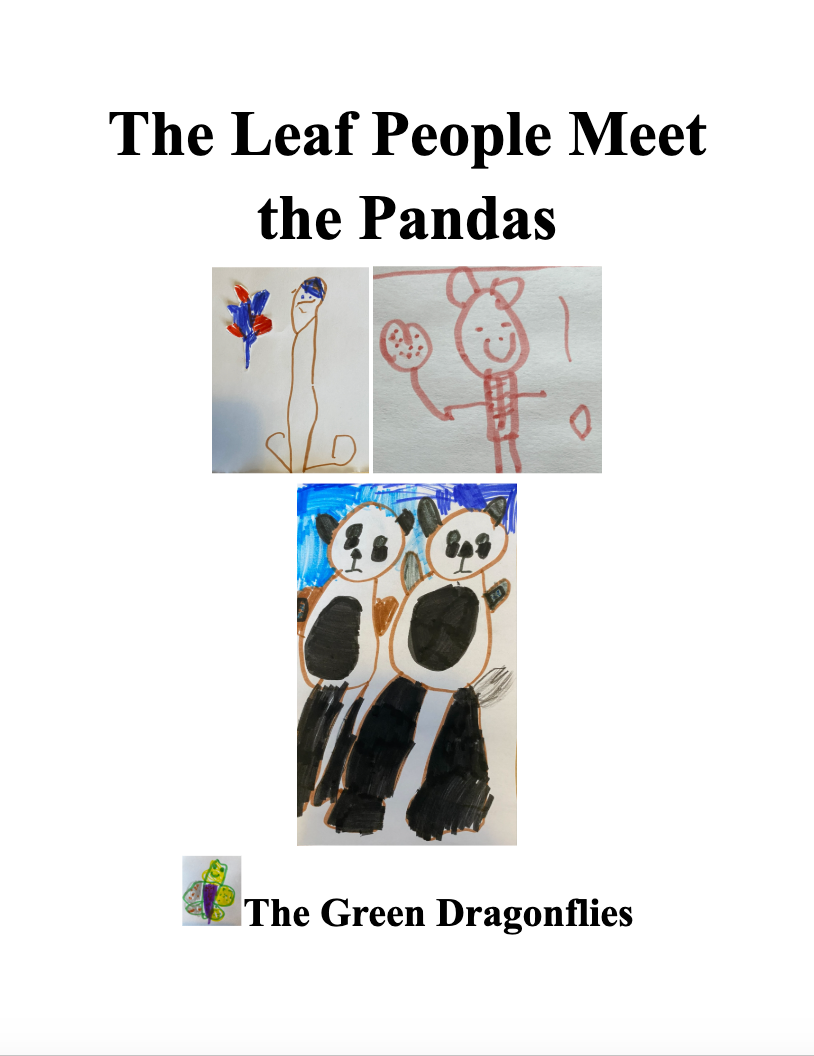
I decided to help create an episode about Leaf People where the Dragonflies would answer the Purple Fish’s questions, and where I could ask questions that would direct the children’s attention towards care. The story of the Leaf People and the Pandas overcoming their initial suspicions and becoming friends seemed a rich vein to discuss. For the podcast I asked small groups of Dragonflies about the story and about making friends generally.
Ben: In the Leaf People Meet the Pandas the two groups become friends. How do you get to be friends?
Josh: You just have to see who likes you and you like who and then if you get to know each other well you can get along and be friends.
Ben: How do you know when you don’t know somebody yet? What are ways to get to know somebody and become friends?
Josh: Play with them.
Caleb: If you become friends it takes a long time. And if you really know each other and you get married and you get divorce and then you get married again and you get divorced and you get married again and you get divorced but then you get married for your whole life.
Ben: It sounds like you can be friends and have a fight, and you can still be friends afterwards. Is that right?
Caleb: Yeah.
Ben: When you have a fight with one of your friends how do you make up and still be friends?
Josh: You can say, “This is it. Don’t do any more of this argument.” And we can keep playing.
Ben: Viola, can you explain how you get to be friends with somebody?
Viola: We meet each other and greet each other and we love each other. That's how we get to be friends.
Ben: Josh do you have anything to add?
Josh: Well, in the Leaf People stories the Leaf People meet the Pandas. That's a reason of how people can get to have friends.
Friendships are a central way young children express and experience care, and in discussing making and maintaining friends the Dragonflies are articulating strategies to come to and continue to care. It is not surprising that Josh, Caleb, and Viola had a lot to say on the topic. Throughout their year as Green Dragonflies, and in previous years at Newtowne, caring for friends was a large part of the curriculum. It is also not surprising that when I asked other Dragonflies about the trio’s thoughts they agreed. Playing together was the consensus activity among Green Dragonflies on how to start to care about someone and become friends.
Questions about the Leaf People books (Part 2): Is it OK that the Leaf People die?
There was no consensus on another question about the Leaf People books: that the Leaf People died in the third book (titled The Leaf People vs. The Sharks). It is the sequel to The Leaf People’s Next Adventure, which ends with the ominous line, “But the shark came back and ate the Leaf People’s house (to be continued).” In The Sharks vs. the Leaf People the entire Newtowne School is destroyed by the sharks and the Leaf People die. Spoiler alert: in the end the Leaf People come back to life and the school is rebuilt.
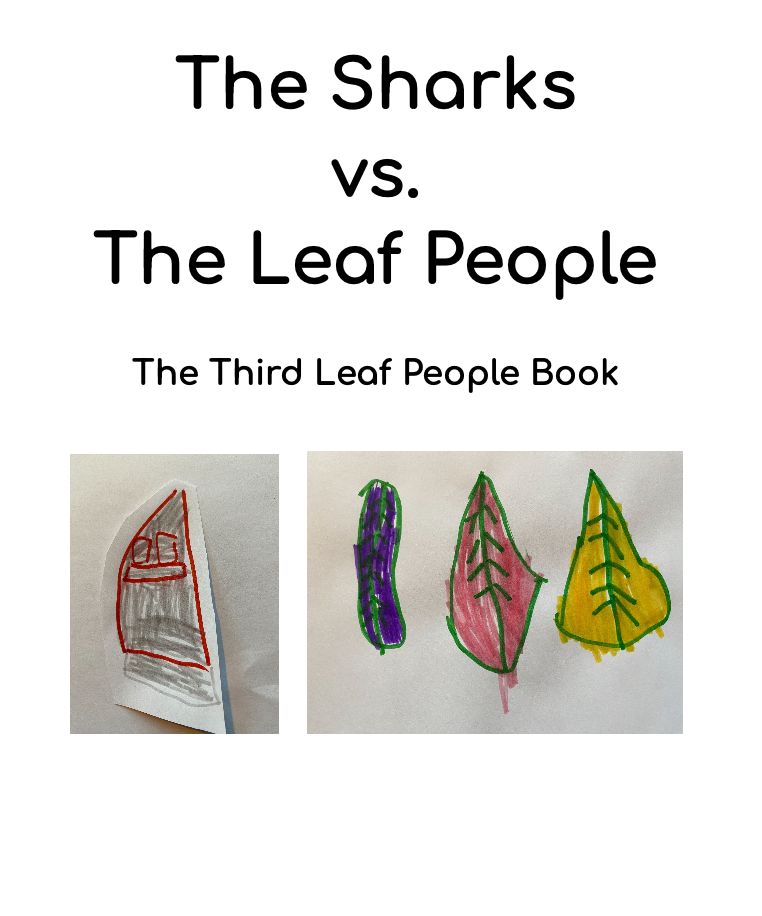
Dragonfly Anika was disturbed that the Leaf People died. She was not convinced when Caleb explained that this was OK because they came back to life. In my teaching I am on the alert for such disagreements, seeing them as opportunities for children to advocate, listen, and reach mutually acceptable solutions to problems that arise in our community.
In asking children about the issue for the podcast my goal was not to steer the children towards non-violence in the story. As Vivian Paley, the long-time kindergarten teacher and a leading theorist of play explains, “Boys have a profound need, as did Shakespeare apparently, to act out pictures of violence.” Death and violence are part of life and Paley wisely counseled that young children be given the opportunity to make sense of this part of the world in their stories.
My goal in raising the question with the Green Dragonflies was to give the children an opportunity to wrestle with how to take care of everyone in their classroom community. The question was how to address Anika’s discomfort and respect Caleb’s needs to tell his story.
Here are excerpts of two small groups conversations:
Ben: In this book The Sharks vs. The Leaf People there are many times when the sharks die and when the Leaf People die too, but then they come back to life. When Anika was thinking about this story, she said she didn’t like that the Leaf People died. Caleb said it was OK because the Leaf People came back to life. I am wondering how you feel.
Kai: The same as Caleb.
Michael: I have something to add.
Lienna: In real life people do not come back to life once they die.
Ben: Do you think it is OK to have death in the story?
Kai: I think it is OK.
Lienna: No.
Ben: Why Lienna? Do you want it to be like real life?
Lienna: Yes.
Ben: And Michael, you had something to add.
Michael: I think it shouldn't be a “versus” story. I think we should actually change the book into a different one.
Ben: How would you change it Michael?
Kai: Wait. We could make a book and I have one piece for the book.
Michael: I’m still talking Kai.
Ben: Why don’t you share your thoughts Michael.
Michael: And we should actually make a book that’s about there being friends.
Ben: Cool. That’s an idea. Kai, what are you thinking?
Kai: Maybe in the book, instead of them being bad they could have a staring contest and who loses the staring contest goes away and never comes back again.
Ben: What do you guys think of a staring contest instead of them dying?
Lienna: I like it.
Michael: I actually think we should make Sharks vs. The Fishies because sharks eat fishies.
The next day I explained Anika and Caleb’s disagreement, and Michael’s idea to change the book, to Maverick, Noel, and Maya.
Maverick: Take the page out so they make friends with the sharks.
Ben: Maya and Noel, what do you think? Should the Leaf People die or should we change the story?
Noel: Change the story.
Ben: How should we change it?
Noel: Cut it out.
Maya: Cut out and write a new page.
Ben: What should the new page say?
Maverick: I know. The Leaf People had a dance party and the Sharks came to the dance party. And they got to be friends.
The Green Dragonflies generated a range of responses to Anika’s discomfort with the Leaf People dying: keeping the story the same (Caleb); changing the conflict to a steering contest (Kai); and eliminating the conflict and having the Leaf People and Sharks become friends (Michael, Maverick, Maya, and Noel). A good start.
But the hard work of deciding what option to go with, a process that would have necessitated compromise and care, did not take place. These conversations took place at the end of the school year. There was a lot going on. I did not help the children take the conversations further than what I have shared above. We ran out of time.
What might the Blue Otters say?
Or maybe I didn’t. In a recent blog post about time Susan MacKay of Center for Playful Inquiry quotes her colleague Matt Karlsen regarding time at Opal School, a Pre-K through 5th grade school in Portland, Oregon, where they were pedagogical leaders. Matt explains that at Opal there was:
[A] sense of multiple time arcs being invoked simultaneously. There was what the children were involved in at the moment, and there were traces of what had happened at other times everywhere around them - images and words captured the previous day, week, or even years earlier. And that a past artifact would easily find its way into conversation: you’d hear a child referencing something their friend had said that offered new insight into the topic at hand, and then you’d realize that she had said that several years ago - a time travel supported by the tangible record on the wall.
That’s looking back in time, but it perhaps also worked going forward: There was always a welcoming of serendipity, of new possibilities, of wild imagination that unrooted the experience from the challenges of the day.
Perhaps the Sharks vs. The Leaf People is such an artifact and could lead to unforeseen possibilities. Six months on, the Purple Fish, who were so enthralled with the Leaf People books, are in the Blue Otter classroom. They continue to be interested in the Leaf People books. Recently Louise was having snack in the studio and asked me to read the Sharks vs. The Leaf People. Several days later Benjamin made the same request.
Maybe I have not run out of time. Maybe the issue of how to take care of Anika and Caleb can be addressed by the Blue Otters. And just this past week Caleb and his mom stopped by Newtowne to say hello. I have Anika and Caleb's families’ emails, so they can potentially be part of the process too. Stay tuned.
Thanks to Mara Krechevsky, Amy Rothschild, and Liz Merrill for their kind and specific feedback on a previous draft of this essay.